Open an Indian wardrobe the week before a wedding and the scene repeats. Shelves are stacked, the bed is covered in rejected options, and someone announces there is nothing to wear.
Wearhousz is an AI wardrobe app built for that moment. Users photograph what they own, and the software proposes outfits from those pieces. Guraanssh Bhurjee leads the company behind it, Wardrobe Management Technologies Private Limited. It is bootstrapped and describes itself as at early revenue stage, though it has not shared figures.
Why full closets still feel empty
A 2018 survey of 18,000 households in 20 countries by relocation firm Movinga, reported by FashionUnited, found people badly misjudge how much of their wardrobe sits unused. Belgian respondents guessed 26%. The real figure was 88%. The study is dated and came from a removals company, so treat the exact percentages with care. The direction is easy to believe.
The money in fashion points the other way. Redseer expects India’s online retail market to cross $90 billion in 2026, with fashion still the largest online category, according to BW Retail World. Almost all of that spend goes into getting people to buy something. Very little goes into getting them to wear what they already own. An AI wardrobe app sits in that gap.
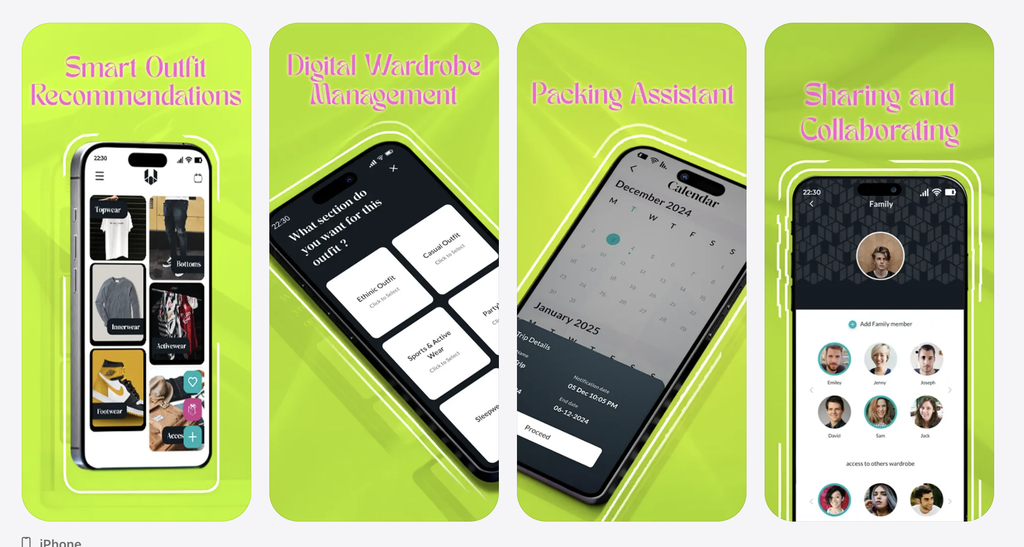
How the Wearhousz AI wardrobe app works
The core loop is simple. A user photographs clothes and accessories to build a digital inventory, sorts and searches it, then mixes pieces into outfits. Looks can be saved to a calendar for a week or an event. The founder says computer vision handles garment recognition. The store listing says little about the models underneath, which is a fair question for any investor to ask.
Version 2.0 widened the product. An AI Style Assistant answers outfit requests in a chat and lets users save a look in one tap. A Trip Planner picks outfits for each destination, and Style Stats shows how someone actually dresses. Family Sharing lets several people in one household use the same wardrobe.
Why trip planning and family sharing matter
Packing is the moment wardrobe knowledge pays off most clearly. A user who has already catalogued a closet can build a suitcase in minutes, and that is an easy story to tell a friend. Family sharing does something different. One paying household brings several people into the habit, and each added wardrobe makes quitting harder. In my read, those two features do more for retention than any styling trick.
What Wearhousz charges
The App Store lists the app’s monthly plan at ₹99 and a yearly plan at ₹699, about ₹58 a month. Pricier tiers go up to ₹9,900 a year, which suggests the team is still testing what people will pay.
The Pro perks hint at a second business. They include member discounts, early sale alerts and access to new collections. That reads like a commerce layer, where brands pay to reach a shopper who has just shown the app what is already in the closet. A wardrobe profile tells a retailer which gaps are worth selling into. That is where I would look for the larger revenue line, though the company has not confirmed it.
A crowded category with a narrow gap
The AI wardrobe app idea is not new. Meitu’s WearWow and the open-source Wardrowbe both pitch AI outfit planning from clothes you own, and dozens of smaller apps do the same. Many were built around Western wardrobes.
That leaves room for local fit. Sarees, kurtas, lehengas and festive layering are hard cases for garment recognition, and rupee pricing helps with adoption. If Wearhousz handles them well, that is a defensible edge, and it is easy to demonstrate in public.
What investors and founders should watch
The tailwinds are real. Smartphone shopping keeps widening, and a wardrobe dataset is hard for a competitor to copy because each user builds it by hand. A low-priced subscription also keeps the first purchase decision small.
The risks are just as concrete. Cataloguing a closet takes effort in any AI wardrobe app, and most users who stall will stall there. The listing shows only four ratings, so public traction signals are thin. Wardrobe photos and purchase interest are personal data, and the listing says some usage data may be used for tracking. The founder will need a clear privacy answer for buyers and brand partners.
The markers I would watch are the share of new users who finish uploading a first batch of items, weekly return rates, and paid conversion at ₹99. Any one of them, published honestly, would say more than a feature list.
The bigger bet
Fashion tech has spent a decade helping people buy more. Wearhousz is betting its AI wardrobe app can win by helping people use what they have. If the app can make its first fifty uploaded items feel useful on day one, it stops being a digital closet and becomes the place where a person decides what to wear every morning. Brands will pay to be in that conversation.
Frequently asked questions
What is Wearhousz?
Wearhousz is an AI wardrobe app from Wardrobe Management Technologies Private Limited. It builds a digital inventory of a user’s clothes, then suggests outfits, plans trips and tracks style habits.
Who is behind Wearhousz?
Guraanssh Bhurjee leads the company. It is a bootstrapped Indian startup, and its app has been on the iOS App Store since early 2025.
How much does the Wearhousz AI wardrobe app cost?
The App Store lists the app’s monthly plan at ₹99 and a yearly plan at ₹699, with higher tiers available. The app is free to download.
Is Wearhousz available on Android?
The App Store listing shows iPhone only. The company has not announced an Android version.
Related : https://launch91.com/startups/ai-fashion-photography-platform-sareeviz/