A contract gets signed in an afternoon. Getting paid for it can take a quarter.
India’s micro, small and medium enterprises were owed ₹7.34 lakh crore in delayed payments as of March 2024, according to the Delayed Payments Report 3.0 from GAME, FISME and C2FO, as Storyboard18 reported. It is money small firms earned and cannot use.
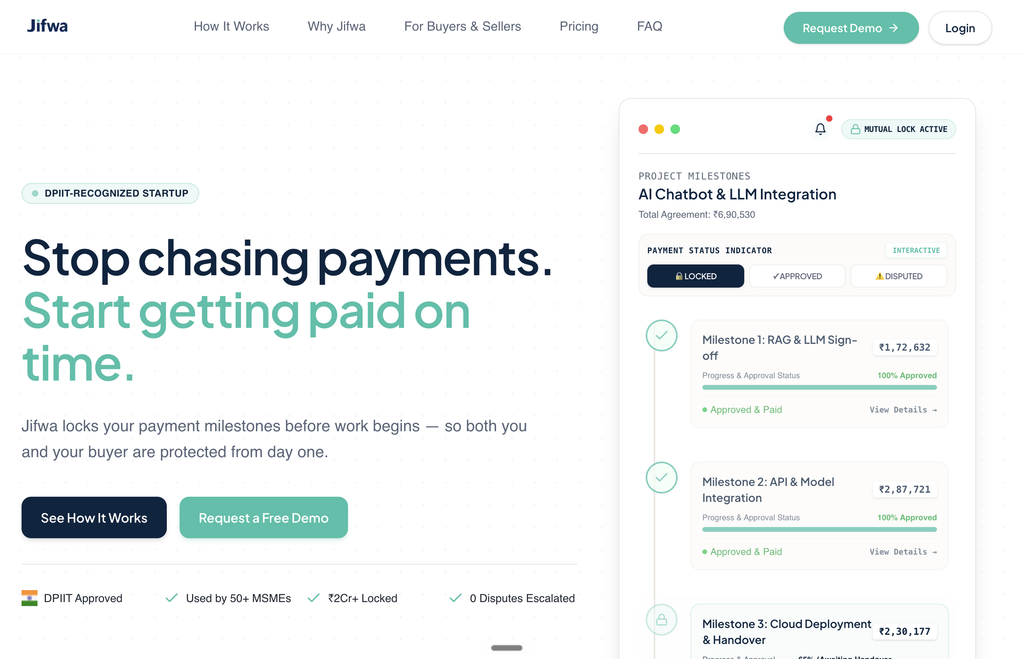
Jifwa is building a contract execution platform for the stretch between the signature and the payout. The Maharashtra startup asks a buyer and a vendor to agree on payment milestones before work starts, then tracks delivery, approvals, proof of work and reminders in one shared workspace. Once both sides lock the terms, neither can quietly change them.
Why India’s payment problem starts after the signature
Most contract software is built for drafting and signing. The damage tends to happen later.
World Commerce & Contracting puts average contract value erosion at 8.6% in research with Deloitte. Cost overruns, scope arguments and avoidable disputes eat the gap between what a deal promised and what it delivered.
For a large enterprise, that is a margin problem. For a five-person design agency in Pune, it decides whether payroll clears. Credit-risk platform Recordent’s 2026 study of about 1.1 lakh MSMEs found the average small business takes 73 days to settle an invoice, as Telangana Today reported. Cases on the government’s MSME Samadhaan portal involved ₹31,039 crore in pending dues as of December 2025, per Swarajya.
Milestones are agreed on a call, confirmed on WhatsApp, revised by email and tracked in someone’s spreadsheet. When the buyer later questions what “final delivery” meant, the vendor holds fragments. Fragments lose arguments.
How Jifwa’s contract execution platform works
Jifwa’s answer is a feature it calls Mutual Milestone Lock. The buyer and seller define each payment stage together, say a sum on design sign-off, another on delivery and the balance on handover. Both confirm. The terms are then locked and timestamped, and changing them needs both parties again.
From there, the contract execution platform runs the routine work. The vendor marks a milestone complete and attaches evidence such as a staging link, a code commit or an e-way bill. The buyer gets an approval link over SMS or WhatsApp, reviews it and releases payment. An AI parser reads uploaded agreements to pull out milestones and deadlines, flags risky clauses and sends reminders before dates slip.
Its FAQ says Jifwa does not hold customer funds. Its job is to create an agreed record and push both sides toward settlement.
The 45-day rule gives buyers a reason to care
Since April 1, 2024, Section 43B(h) of the Income Tax Act has tied a buyer’s tax deduction to paying micro and small suppliers on time. Under the MSMED Act, that means within the agreed term, capped at 45 days from acceptance of goods or services, or within 15 days without a written agreement, as Business Standard explained.
That rule changes the sales pitch. A buyer’s finance team now needs to know when work was accepted and what terms were agreed in writing. A timestamped approval on a shared record answers both. The vendor gets a stronger hand and the buyer gets an audit trail.
In my read, that two-sided value is the strongest part of Jifwa’s design. Tools that only serve the party owed money rarely get the paying side to log in.
How Jifwa prices its contract execution platform
Jifwa sells on a self-serve ladder. The Starter plan costs ₹999 a month for five active contracts. The Agency plan at ₹2,499 adds a client sign-off portal and a dispute workflow, and the Studio tier at ₹4,999 opens unlimited contracts and ERP integrations.
A transaction layer sits on top, with a 1% fee per invoice settled, capped at ₹300 a month. Jifwa also says it plans a link to TReDS, the RBI-regulated exchanges where MSMEs sell approved invoices to financiers at a discount.
That piece could matter most. An approved milestone is close to an approved invoice. If Jifwa can pass that approval straight into invoice discounting, the vendor gets cash in days instead of waiting out the buyer’s cycle.
The founders and the bootstrapped road
Jifwa is run by Conseccomms Private Limited, incorporated in 2025 and recognised by DPIIT. It is based in Chopda, in Maharashtra’s Jalgaon district.
Founder and CEO Mohammed Shoeb Shaikh spent more than ten years at Cognizant, Amazon and Wipro, where he watched payment disputes sour vendor relationships. Co-founder and CTO Vardhman Jain built the AI parser and milestone engine. Co-founder Faisal Shaikh runs operations and compliance as COO. Follow the company on LinkedIn.
The company is bootstrapped and at pre-seed stage. It launched on Product Hunt in 2026 and says more than 50 MSMEs use its contract execution platform, with over ₹2 crore in milestone value locked and no disputes escalated. Those figures have not been independently verified.
What investors and founders should watch
The tailwinds are real. Delayed payments are a policy priority, the 45-day rule pushed buyers toward documented terms, and a contract execution platform sitting on the payment flow has a natural path from subscription revenue to transaction revenue.
The risks are concrete. Jifwa’s website uses escrow language in places while its FAQ says it holds no funds. Moving money for others in India requires RBI payment aggregator authorisation or a regulated escrow partner, and the company will need to make that structure explicit. Digital escrow players such as Castler and Escrowpay already sell milestone-based payouts to businesses, so Jifwa’s edge has to come from the workflow and the AI layer.
Distribution is the harder problem. Small vendors rarely have the power to make a large buyer adopt new software. The 45-day rule hands Jifwa an argument for the buyer’s CFO, and CA firms or MSME associations may be the fastest channel to make it.
The marker I’d watch is a named enterprise buyer moving its vendor base onto Jifwa, followed by published data on how many days the platform cuts from the average payment cycle.
The bigger bet
India digitised the signature years ago. The weeks after it still run on chat threads and goodwill.
Jifwa is betting that a contract execution platform both sides trust can make on-time payment the default for small businesses. If the locked milestone becomes the record that buyers, vendors and lenders all accept, Jifwa stops being a reminder tool and becomes part of how MSME credit moves.
Frequently asked questions
What is Jifwa?
Jifwa is an AI-powered contract execution platform from India. It helps buyers and vendors agree on payment milestones, track delivery and approvals, and keep a timestamped record of each step.
How does Mutual Milestone Lock work?
Both parties confirm payment milestones before work begins. The terms are then locked, so neither side can change them without the other’s approval.
Does Jifwa hold payments in escrow?
According to its FAQ, Jifwa does not hold funds. Its contract execution platform records agreed terms and approvals and notifies both parties when a payment is due.
Related : https://launch91.com/policy/imf-global-outlook-spending-ai-risks-startups-2026/