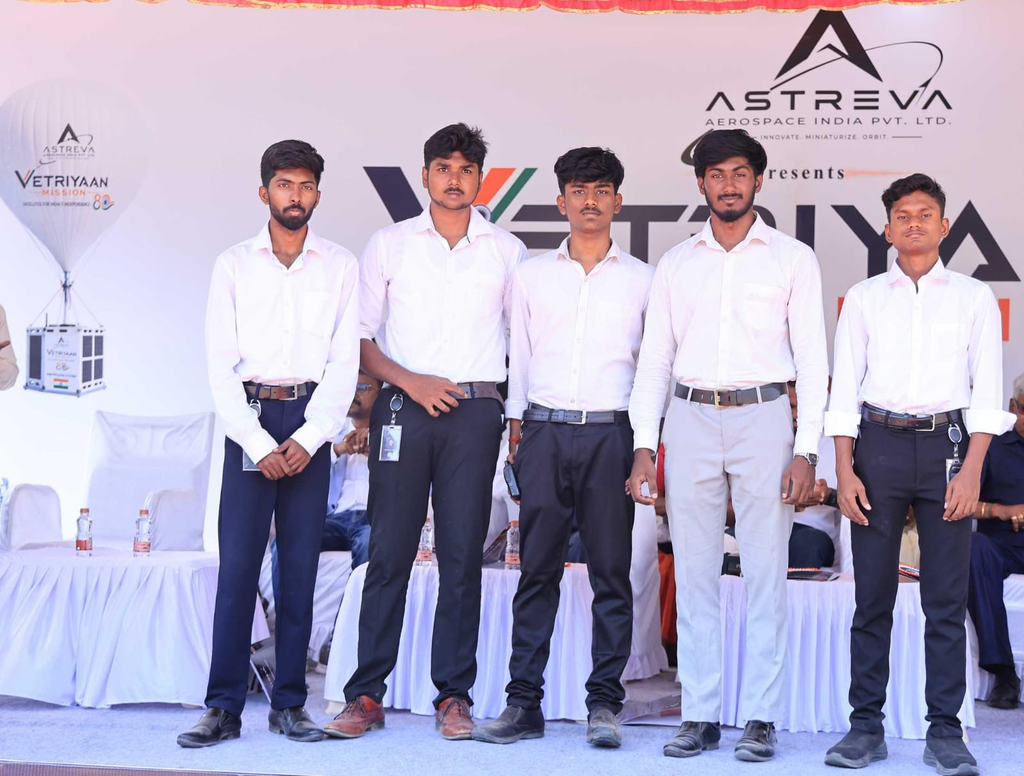
A science exhibition prize rarely becomes a company. For Astreva Aerospace, it did.
Astreva Aerospace India Pvt Ltd is an early-stage Indian spacetech startup building small and nano satellite technologies, scientific payloads and near-space missions. Its flagship programme, VETRIYAAN, is designed to lift experiments into the upper atmosphere. Founder Raghavan traces the company back to a single afternoon with a Mars rover, and a room of ISRO scientists who took it seriously.
The story lands during World Space Week, which runs from October 4 to 10 every year. Fitting, because that is where it started.
What is Astreva Aerospace?
Astreva Aerospace is an Indian space technology company focused on miniaturised spacecraft. The team works across three areas: small and nano satellite systems, scientific payloads, and near-space flights that test hardware in conditions close to space. Its motto is “Innovate. Miniaturize. Orbit.”
A Mars rover in Vellore that changed the plan
The turning point came at a World Space Week event organised by ISRO’s Satish Dhawan Space Centre (SDSC SHAR) in Vellore. Raghavan designed and presented a large autonomous Mars rover. It won first prize.
The trophy mattered less than the feedback. Scientists from the centre that launches India’s rockets studied the build and encouraged it. That response turned an interest into a harder question. What would it take to build hardware that actually flies?
Raghavan and the team spent the following period studying the industry. One segment kept pulling them back.
Why Astreva Aerospace is betting on small satellites
Space missions used to mean large spacecraft, long build cycles and budgets only governments could carry. Miniaturisation changed that math. A nanosatellite weighs between 1 and 10 kg, and the most common format, the CubeSat, is built from 10 cm cubes, according to a research survey on small satellites.
The market is growing fast, though forecasts vary. Polaris Market Research valued the global nanosatellite and microsatellite market at about $4.86 billion in 2025 and projects $30.5 billion by 2034. Growth Market Reports has a lower curve, from $4.5 billion to $21.2 billion over the same period. Even the conservative number is a market that roughly quadruples in nine years.
India’s own numbers make the case sharper. The government told Parliament in February 2026 that 399 space startups were registered on the Startup India portal, yet Indian startups had flown only seven satellites and 20 payloads in total, according to a PIB statement. By August, the startup count had risen to about 440, as All India Radio reported.
That gap is the real story. Hundreds of companies, very little flown hardware. In space, flight heritage is the credential every customer asks for first, and most young teams don’t have it. Astreva Aerospace is designing its path around earning it early.
VETRIYAAN: rehearsing for orbit in near space
VETRIYAAN is Astreva Aerospace’s near-space mission, built to carry experiments and payloads into the high-altitude atmosphere. Near space sits above where airliners fly and below where satellites orbit, roughly 20 to 100 km up. At 30 km, air pressure is around 1% of sea level and temperatures drop far below freezing.
Those conditions make near space a practical test range. A payload that survives the cold, the thin air and the radiation of a high-altitude flight has data behind it before it ever books a rocket. The cost and lead time are a fraction of an orbital launch.
The category is forming in real time. In May 2026, Vijayawada-based Red Balloon Aerospace flew Mission SANA, India’s first indigenous super-pressure stratospheric balloon carrying commercial payloads, to about 25 km, as The Machine Maker reported. Demand for near-space rides is clearly there.
For the Astreva team, VETRIYAAN is less a one-off flight and more a working method. Build a payload, fly it, read the data, rebuild. That loop is how a student-scale rover team grows into a satellite company.
Innovate. Miniaturize. Orbit.
The company’s three-word motto reads like a sequence. Innovate boldly. Miniaturise with intent. Then build toward orbit.
I like the order. Orbit comes last, after the team has tested hardware worth sending there. In deep tech, where capital is scarce and failures are public, that patience is a strategy. Each step produces something a partner, a university lab or an investor can actually evaluate.
What investors and founders should watch
Astreva Aerospace is early, and the founders say so openly. The useful question for investors is what signals will show progress.
The first is VETRIYAAN’s flight results. Altitude reached, payloads carried and data recovered will tell the market more than any pitch deck. The second is who rides along. Universities and research labs that need cheap access to high-altitude conditions are natural first customers, and each one adds credibility.
Support is also easier to reach than it was five years ago. IN-SPACe runs a seed funding scheme of up to ₹1 crore for space startups, and its decadal vision targets a $44 billion Indian space economy by 2033. Indian space startups have raised about $380 million to $390 million over the last three years.
The risk is the usual one for hardware. Moving from near-space tests to a flight-qualified satellite takes more money, more people and more time than any early team expects.
From curiosity to capability
India’s space headlines this year belong to rockets, led by Skyroot’s Vikram-1 becoming the first privately built Indian rocket to reach orbit. The next chapter will be written by the teams building what those rockets carry.
Astreva Aerospace started with a rover, a prize and a question it chose not to drop. If VETRIYAAN delivers, the company will hold something more useful than ambition: data from the edge of space, from hardware its own team built. Follow the journey on the Astreva Aerospace website and LinkedIn.
Frequently asked questions
What does Astreva Aerospace do?
Astreva Aerospace India Pvt Ltd develops small and nano satellite technologies, scientific payloads and near-space missions from India.
What is VETRIYAAN?
VETRIYAAN is Astreva Aerospace’s near-space mission, designed to carry experiments and payloads into the high-altitude atmosphere for real-world testing.
Who founded Astreva Aerospace?
Astreva Aerospace was founded by Raghavan and team after his autonomous Mars rover won first prize at a World Space Week event organised by ISRO’s SDSC SHAR.
Related : https://launch91.com/policy/boeing-737-max-software-glitch-indian-airlines-akasa-air-order/