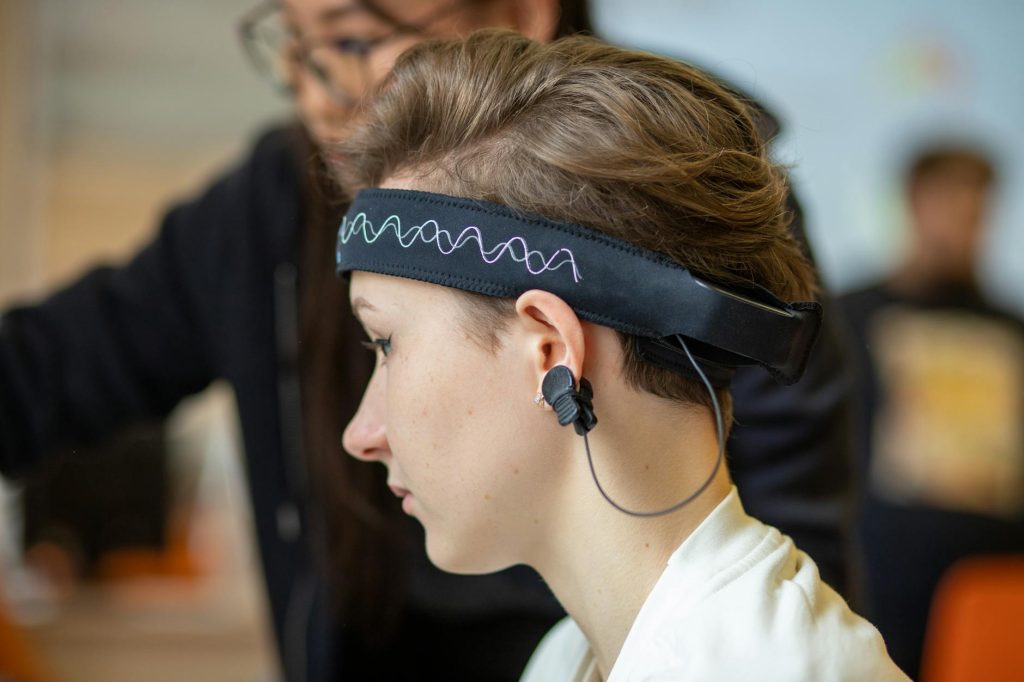
For decades, our headphones have been a one-way street. We push play, and the world floods in through a curated stream of music, podcasts, or conference calls. They are our shields against the open-plan office, our companions on a morning run, our private concert halls on a crowded metro. But what if they could do more? What if, instead of just piping sound in, they could listen to the subtle signals of our own minds and bodies, and actively work to make us feel better? What if your headphones knew you were stressed before you did, and could gently nudge your brain towards a state of calm focus?
This is the audacious question at the heart of Sychedelic, a Gurugram and New York-based neurotech startup that just closed a $3.5 million seed round. Founders Ria Rustagi and Bhavya aren’t just building another pair of noise-cancelling headphones. They are building what they call the world’s first “closed-loop neuromodulation wearable” in a familiar, everyday form factor. It’s a mouthful, but the concept is profound. It’s a device designed not just to be heard, but to listen back to your body, creating a real-time feedback loop to enhance mental wellness.
The funding round, a significant seed for a hardware-plus-AI venture, was led by a consortium of investors including TurboStart, Ideabaaz, and Praveek Ventures, with participation from a network of angel investors across India, the UAE, and the global NRI community. This isn’t just a vote of confidence in a product; it’s a bet on a future where personal technology becomes deeply, actively personal.
The Problem: Beyond Blocking Out Noise
The modern knowledge worker’s struggle is a quiet one. It’s the constant hum of digital distraction, the slow burn of cognitive overload, and the elusive search for “deep work” in a world of shallow tasks. We’ve turned to a patchwork of solutions. Meditation apps like Calm and Headspace have become unicorns by offering guided mindfulness. Productivity software promises to fence off our digital distractions. But these are largely behavioural interventions. They require conscious effort and discipline, which are often the first resources to deplete when we’re stressed or burned out.
Sychedelic’s approach is different. It targets the physiological root, not just the behavioural symptom. The founders saw a massive gap in the market between passive wellness apps and intensive, clinical neurofeedback treatments that are inaccessible and expensive for most people. They envisioned a device that could bridge this gap, offering a proactive, data-driven tool for everyday mental hygiene.
This isn’t about drowning out the world; it’s about fine-tuning the mind. It’s for the developer trying to find flow, the student cramming for an exam, or anyone trying to transition from a high-stress workday to a restful evening. The goal is to move from a reactive state of managing stress to a proactive state of cultivating focus, calm, and better sleep.
Deconstructing the Tech: Neuromodulation in a Headphone
The term “closed-loop neuromodulation” sounds like something out of science fiction, but the principles are grounded in established science. Here’s how Sychedelic’s system works.
- The ‘Listen’ Phase: The headphones are equipped with biometric sensors that continuously track key indicators of your mental state. The most important of these is Heart Rate Variability (HRV), a powerful metric that reflects the state of your autonomic nervous system. Low HRV is often linked to stress, fatigue, and burnout, while high HRV indicates a state of calm, recovery, and resilience.
- The ‘Analyze’ Phase: An onboard AI algorithm processes this biometric data in real time. It learns your personal baselines and identifies deviations that suggest you’re losing focus, feeling stressed, or are mentally fatigued.
- The ‘Respond’ Phase: This is where the neuromodulation comes in. Based on the analysis, the device delivers personalized neurostimulation designed to guide your brain activity towards a more desirable state. It does this through a combination of techniques.
One of the core technologies is transcranial Direct Current Stimulation (tDCS). This involves applying a very low, imperceptible electrical current to specific areas of the scalp. It’s a non-invasive technique that has been studied for decades for its potential to enhance cognitive functions like memory, learning, and attention. By gently encouraging neural activity in targeted brain regions, the headphones can help promote states of focus or relaxation.
The system also uses binaural beats, an auditory illusion where two different tones played in each ear create the perception of a third, rhythmic beat inside the head. This perceived beat can influence brainwave patterns, a process known as brainwave entrainment, to encourage states like deep relaxation (delta waves) or heightened alertness (beta waves).
This entire process is a continuous, adaptive loop. The device senses your HRV dipping, delivers a subtle combination of tDCS and auditory beats to counteract the stress response, and then monitors your biometrics to see if it worked, adjusting its approach accordingly. It’s a dynamic partnership between you and your technology.
The Go-To-Market: Kickstarter, Community, and Credibility
With $3.5 million (approximately ₹31.5 crore) in the bank, Sychedelic has a clear roadmap. The capital injection is earmarked for three critical pillars: scaling up manufacturing, deepening research and development, and funding a global launch.
Their GTM strategy is a smart page from the modern hardware playbook. The company is preparing for a global Kickstarter launch this very month, in May 2026. This isn’t just about pre-sales. A Kickstarter campaign for a product this ambitious serves multiple purposes.
They are building a new category somewhere between a meditation app and a clinical device, and that requires educating the market one early adopter at a time.
First, it’s the ultimate test of product-market fit. It validates demand directly with the people most likely to buy, the tech-savvy early adopters who actively seek out innovation. Second, it builds a foundational community of evangelists who can provide invaluable feedback and generate authentic buzz. For a hardware startup, managing cash flow and inventory is everything. A successful crowdfunding campaign de-risks the first major manufacturing run by funding it with customer orders.
The Gurugram-New York dual-HQ structure is also telling. It’s a playbook we’re seeing more of from ambitious Indian founders. It allows them to tap into India’s formidable engineering and R&D talent pool while establishing a strong foothold in the US, the world’s largest and most mature market for wellness and consumer technology. This strategic positioning signals a global-from-day-one mindset.
The Bigger Picture: A New Wave in Indian Deeptech
Sychedelic’s journey is emblematic of a broader, exciting shift in the Indian startup ecosystem. For years, the narrative was dominated by e-commerce marketplaces, fintech payment solutions, and SaaS for the world. While those pillars remain strong, a new generation of founders is tackling fundamentally harder problems in deeptech, healthtech, and advanced hardware.
These are ventures that require a different kind of patience from investors and a different kind of grit from founders. The R&D cycles are longer, the capital expenditure on manufacturing is higher, and the path to PMF often involves navigating complex science and regulatory landscapes. But the potential impact is an order of magnitude greater.
Furthermore, the timing is perfect. The conversation around mental health in India has finally moved from the fringes to the mainstream. A young, digitally native population is more aware of concepts like burnout and cognitive wellness than any generation before it. They are actively seeking tools that go beyond simple entertainment or productivity.
Of course, the road ahead for Sychedelic will have its challenges. They will need to meticulously manage their supply chain. They will have to clearly communicate the science behind their product without overstating claims, a delicate balance in the wellness industry. And as they pioneer this new category of “neuro-adaptive wearables,” they will inevitably attract the attention of consumer electronics giants.
But for now, Ria Rustagi and Bhavya have the capital, the vision, and a genuinely innovative product that speaks to a deep and growing human need. They aren’t just launching another gadget. They are asking us to reimagine our relationship with technology, turning a passive listening device into an active partner in our own mental well-being. And that’s a frequency worth tuning into.