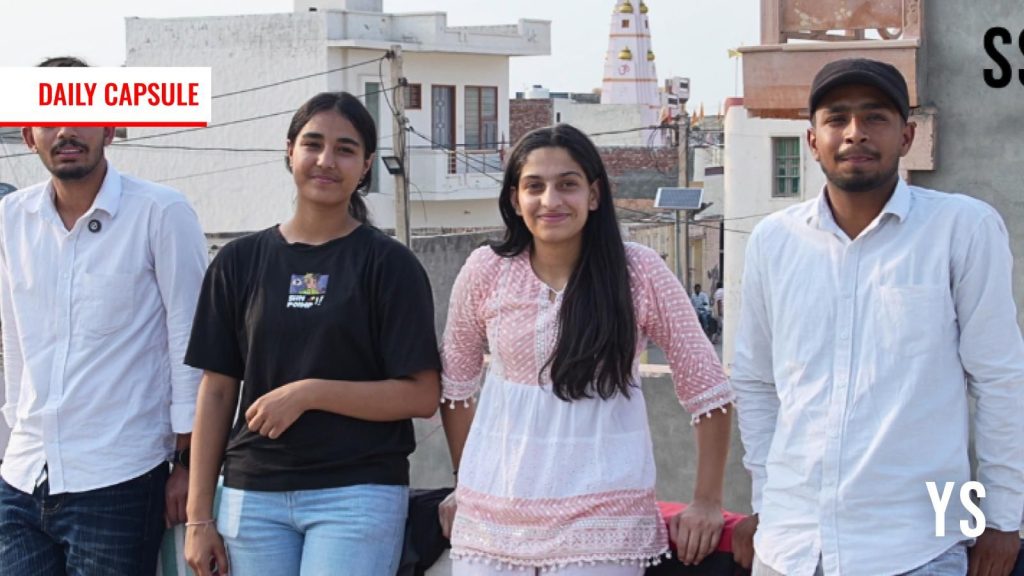
In the bustling heart of India’s startup ecosystem, where billion-dollar valuations and rapid scaling often dominate headlines, it’s easy to overlook the quiet genesis of innovation happening at a grassroots level. Yet, some of the most profound solutions emerge not from venture-backed boardrooms, but from the unlikeliest of places: a school classroom in Hisar, Haryana. This is the story of Her Ease, a menstrual wellness solution born from the minds of four high school students, a testament to the power of early-stage entrepreneurship programs in nurturing India’s next generation of problem-solvers.
The Genesis of Her Ease: A School-Led Entrepreneurship Revolution
The journey of Her Ease began not with a sophisticated market study, but with a keen observation of an everyday, deeply personal challenge. Pallavi Kaswan, Pritam Suthar, Anand Bansal, and Neha Loura, students of Aarohi Model Senior Secondary School in Hisar, were participating in the Kushal Business Challenge. This Haryana government-led school entrepreneurship program is designed to ignite the entrepreneurial spark early, encouraging young minds to identify real-world problems and craft viable solutions.
It’s programs like the Kushal Business Challenge that are quietly yet powerfully reshaping the entrepreneurial landscape in India. They bridge the gap between academic learning and practical problem-solving, moving beyond theoretical case studies to hands-on product development and market understanding. These initiatives are crucial, especially in tier-2 and tier-3 cities, where access to traditional incubator networks might be limited. By embedding entrepreneurial thinking within the school curriculum, they are building a pipeline of innovators who understand local pain points intimately.
The team at Her Ease focused on menstrual wellness, a domain often shrouded in societal taboos and a lack of accessible, affordable, and sustainable solutions, particularly in rural and semi-urban India. Their collective empathy and understanding of the challenges faced by women and girls in their own communities provided the foundational insight for their product. This isn’t just about a product; it’s about dignity, health, and breaking down entrenched barriers.
Understanding the “Why”: Tackling a Deep-Rooted Indian Challenge
Menstrual hygiene and wellness remain significant challenges across India, despite growing awareness. Issues range from access to sanitary products, safe disposal methods, and adequate sanitation facilities to the pervasive social stigma that often prevents open discussion and education. A solution like Her Ease, conceptualized by young people who themselves are part of the community experiencing these issues, holds immense potential because it’s built on lived experience, not just market research.
What makes Her Ease particularly compelling is its origin within a government-backed program. The DPIIT (Department for Promotion of Industry and Internal Trade) and initiatives like Startup India have long emphasized the need to foster innovation at every level. The Kushal Business Challenge exemplifies this vision, demonstrating how state governments can play a pivotal role in nurturing entrepreneurial talent from the ground up. This layered support, from local school programs to national recognition, creates a robust ecosystem where even nascent ideas can find a platform to grow.
The success of Her Ease within the challenge signifies a shift. It’s no longer just about tech hubs like Bangalore or Delhi-NCR leading the innovation charge. The entrepreneurial spirit is clearly permeating smaller towns and even schools, suggesting a democratization of startup opportunities. This decentralized growth is vital for India’s long-term economic development, ensuring that innovation isn’t confined to a few metropolitan pockets but is instead a nationwide phenomenon.
The Ecosystem’s Role: Nurturing Early-Stage Dreams
While the immediate spotlight is on the Her Ease team, it’s essential to acknowledge the broader ecosystem that enables such stories. Incubators and accelerators, from the prestigious IITs and IIMs to dedicated programs like NASSCOM’s 10,000 Startups, T-Hub in Hyderabad, and CIIE.CO at IIM Ahmedabad, are the crucial bridge between an idea and a viable business. These institutions provide mentorship, infrastructure, and often, initial seed funding that is indispensable for early-stage founders.
The Kushal Business Challenge, while operating at a school level, essentially functions as a mini-incubator. It provides a structured environment for ideation, problem definition, solution development, and presentation. For students like Pallavi, Pritam, Anand, and Neha, this exposure is invaluable. They learn about market validation, competitive analysis, and the arduous process of bringing a product to life, long before they step into a university or a corporate job.
The influence of ecosystem builders cannot be overstated. Leaders within incubators and accelerators, often veterans of the startup world themselves, act as guides, connecting founders to networks, investors, and resources. Their expertise helps early-stage ventures navigate the treacherous path from concept to product-market fit. Programs that target high school students extend this support even further, instilling an entrepreneurial mindset at an age when creativity and risk-taking are often at their peak.
Consider the typical challenges an early-stage founder faces: lack of capital, limited access to mentors, difficulty in building a team, and the sheer complexity of navigating legal and regulatory frameworks. Programs like the Kushal Business Challenge address several of these by providing a supportive, educational framework. While Her Ease might still be in its nascent stages, the foundation laid by this program is critical for its future trajectory.
Beyond the Product: A Vision for Impact and Sustainability
The specific details of Her Ease, its features, and its proposed business model are yet to fully unfold in the public domain. However, the very premise of a menstrual wellness solution conceptualized by high school students from Hisar speaks volumes. It suggests a focus on accessibility, affordability, and perhaps, an understanding of cultural nuances that larger, more commercial ventures might overlook. This grounded perspective is often the secret sauce for innovations that truly resonate with India-specific pain points.
For instance, if Her Ease incorporates sustainable materials or addresses waste disposal challenges inherent in menstrual hygiene products, it could have a significant environmental impact. If it focuses on community-level distribution or education, its social impact could be transformative. These are the kinds of innovations that don’t just generate revenue; they uplift communities and contribute to broader societal well-being.
The story of Her Ease also highlights the importance of fostering diverse perspectives in entrepreneurship. When young women like Pallavi and Neha are empowered to lead in developing solutions for women’s health, the outcomes are often more relevant and effective. This diversity in thought and experience is a powerful catalyst for truly groundbreaking innovation.
Looking ahead, the journey for Her Ease will involve moving from a successful concept within a competition to a viable, scalable venture. This will mean securing further mentorship, potentially seeking seed funding, refining their product based on user feedback, and developing a robust go-to-market strategy. The ecosystem, with its network of incubators, angel investors, and government support, will be crucial in this next phase. The fact that they’ve already garnered attention through a state-level program is a strong indicator of their potential.
The Future of Early-Stage Innovation in India
The tale of Her Ease is a powerful reminder that India’s entrepreneurial spirit is vibrant and deeply rooted, extending far beyond the well-trodden paths of metropolitan tech hubs. It underscores the critical role of grassroots programs, government initiatives, and dedicated ecosystem builders in identifying and nurturing talent from an early age. As India continues its trajectory towards becoming a global innovation leader, it will be these stories, of young minds tackling real-world problems with ingenuity and empathy, that truly define its entrepreneurial future.
The commitment of the Haryana government through the Kushal Business Challenge, and similar programs across other states, is building a resilient foundation. These initiatives are not just about creating startups; they are about cultivating a mindset of problem-solving, resilience, and self-reliance that will serve these young entrepreneurs, and indeed the nation, for decades to come. Her Ease is more than just a product idea; it’s a beacon of hope for what India’s youngest innovators can achieve when given the right platform and support.