On July 18, 2026, Skyroot’s Vikram-1 reached orbit from Sriharikota. India became the third country with a private orbital launch capability, as Circuit Digest reported. That settled one question. Indian startups can build rockets that get there.
The next question is harder. Can they fly cheaply and often enough to matter to the satellite operators who pay the bills?
Ahmedabad-based OmSpace Rocket and Exploration thinks the answer is a reusable rocket. Its launch vehicle, Infinity One, is designed so the first stage lands on its own legs and flies again within 24 to 48 hours. If that works, a launch stops being a one-off event and starts to look like a scheduled service.
Why India’s small satellite market needs a reusable rocket
Demand is not the problem. IN-SPACe’s decadal vision projects India’s space economy growing from $8.4 billion in 2022 to $44 billion by 2033, including about $11 billion in exports. India had 399 active space startups by January 2026, according to figures shared in Parliament and covered by Machinist. Many build small satellites. Nearly all of them need a ride.
That ride usually means a rideshare slot on a larger vehicle. The satellite flies when the manifest fills, to an orbit chosen for someone else’s primary payload. For a startup burning cash while its hardware sits in a clean room, every month of delay is expensive.
Dedicated small launchers solve the scheduling problem. Cost is a separate fight. A rocket thrown into the sea after every flight has to be rebuilt for the next one, and that rebuild sets the price floor. A reusable rocket attacks the floor itself, which is why OmSpace pitches turnaround time ahead of raw payload.
Inside Infinity One
Most of a reusable rocket’s economics sit in the first stage, the most expensive part to throw away. Infinity One’s first stage carries deployable landing legs that stay folded during ascent and open in the final descent for a vertical touchdown. OmSpace says the booster is then inspected and cleared to fly again within two days. A carbon fibre fairing protects the payload, and an integrated kick stage drops it into the exact orbit the customer asked for. The customer picks the date and the orbit.
A methane engine built for repeat firing
The engine is where the engineering choices get interesting. OmSpace’s in-house cryogenic engine burns bio-methane with liquid oxygen. Methane leaves far less soot than kerosene, which matters for a reusable rocket that has to fire the same engine many times. The company also builds the engine through additive manufacturing. Fewer parts means fewer joints, and joints are where conventional assemblies tend to fail.
This is not paper engineering. OmSpace completed a hot-fire engine test at its Sanand facility in August 2024, according to EDII.
What Gujarat’s first sounding rocket proved
On March 14, 2026, OmSpace launched a single-stage sounding rocket from Bavaliyari village near Dholera, on the Gulf of Khambhat. It was the first rocket launch from Gujarat, flown under IN-SPACe authorisation with state science minister Arjun Modhwadia present, as All India Radio reported.
The flight was modest by design. The rocket climbed to about 3 km, reached transonic speed, carried a small weather-data satellite and came down on a dual-parachute system inside the safety zone. Its 3D-printed torch igniter, sugar-based solid motor and carbon fibre airframe were all built in-house.
Three kilometres is a long way from orbit. Even so, the flight cleared hurdles every launch company has to clear eventually, including avionics, recovery, regulatory sign-off and range safety, all on the first attempt. Skyroot climbed the same ladder. It flew the suborbital Vikram-S in 2022, four years before Vikram-1 reached orbit.
The founders and the money
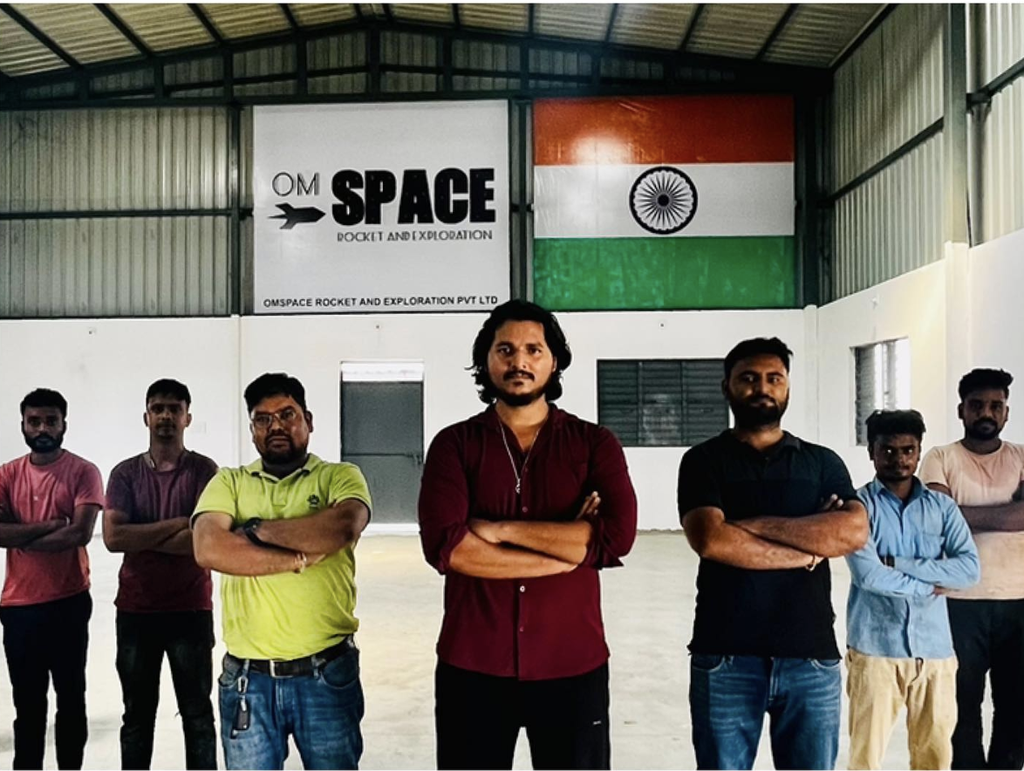
OmSpace was founded in 2020 by Ravindra Raj Binod Mistri (CEO), Maulik Mota (CTO) and Stutika Padamshali (Program Director). Raj is an electrical engineer from NERIST with postgraduate training in power electronics. The company also runs space-technology training programmes for students. Follow its progress on LinkedIn.
The capital story is lean. OmSpace was incubated at CrAdLE, EDII’s technology incubator, from 2021 to 2023 and received ₹10 lakh under the Startup India Seed Fund Scheme. It joined AWS’s space accelerator programme. In July 2025 it raised $3 million in a pre-seed round from family offices and angel investors. The company says the money funds Infinity One prototype tests, a bigger R&D team and ground systems. It has also set up a UAE arm, OSRE FZC, and targets a first commercial launch in January 2028.
At its Emergence 6.0 anniversary event in July 2026, OmSpace unveiled the blueprint for a Gigafactory with assembly cleanrooms and automated composite bays. A cold flow test of its pressure and propellant systems is next.
What investors and founders should watch
My read is that capital discipline is OmSpace’s strongest card. Getting an engine to hot-fire and a rocket to fly on single-digit millions is rare in launch, a sector known for burning money before first flight.
The open questions are real. No Indian company has yet landed the booster of an orbital reusable rocket, so OmSpace carries the full technical risk of a first. Skyroot is already in orbit, though Vikram-1 is not a reusable rocket, and aims to sell commercial flights by 2027. ISRO’s SSLV is moving to HAL through a technology transfer. And the jump from a 3 km sounding flight to a cryogenic orbital stage will need much larger rounds than the company has raised so far.
Three markers will tell the story. Watch the cold flow result, a full-duration methalox hot-fire, and one locked payload figure that customers can price against.
The bigger bet
India has proved it can build a private orbital rocket. The next decade will be decided by who can fly the same hardware twice in one week.
OmSpace is a small Ahmedabad team building toward India’s first commercial reusable rocket. If Infinity One gets anywhere near its 48-hour turnaround, satellite operators will stop buying launches and start booking them.
Frequently asked questions
What is OmSpace Rocket and Exploration?
OmSpace is an Ahmedabad-based spacetech startup founded in 2020. It is building Infinity One, a reusable rocket for small and nano satellites, and flew Gujarat’s first sounding rocket in March 2026.
What makes Infinity One different?
Infinity One is a reusable rocket with a first stage designed to land vertically and can relaunch within 24 to 48 hours. It uses a 3D-printed cryogenic engine running on bio-methane and liquid oxygen.
How much funding has OmSpace raised?
OmSpace raised $3 million in a July 2025 pre-seed round from family offices and angel investors, after earlier support from Thinkuvate and the Startup India Seed Fund Scheme.
Related : https://launch91.com/ai-ml/elon-musk-spacex-ai-slowdown-cursor-acquisition/