The long-heralded future of robotics, where intelligent machines seamlessly integrate into human-centric environments, has often felt like a perpetually distant horizon. Yet, with Agility Robotics’ audacious move to go public through a Special Purpose Acquisition Company (SPAC) merger, valuing the firm at a remarkable $2.5 billion, that horizon suddenly appears much closer. This isn’t just another tech IPO; it represents a pivotal moment for the humanoid robotics industry, validating years of deep tech research and substantial investment in bringing bipedal, AI-driven machines into practical, industrial deployment.
This public offering, anticipated to generate over $620 million in proceeds, including $200 million from a consortium of new and existing institutional investors, positions Agility Robotics at the forefront of a burgeoning market. The company, a spin-out from Oregon State University in 2015, has spent the last decade refining its flagship humanoid robot, Digit, transforming it from an academic marvel into a tangible solution for the acute labor challenges faced by logistics and manufacturing sectors globally. The capital infusion will undoubtedly accelerate Digit’s production, expand its operational footprint, and fuel the advanced AI research critical for its continued evolution.
Digit: The Bipedal Workhorse Redefining Warehouse Logistics
At the core of Agility Robotics’ valuation is Digit, a bipedal humanoid robot designed specifically for complex tasks within dynamic environments, particularly warehouses and industrial settings. Unlike traditional wheeled or tracked autonomous mobile robots (AMRs), Digit’s bipedal locomotion allows it to navigate human-designed spaces, climb stairs, and interact with objects and infrastructure built for human operators. This fundamental design choice is not merely an engineering feat; it’s a strategic decision that unlocks a vast array of potential applications where existing automation solutions fall short.
Digit is optimized for monotonous, repetitive, and often ergonomically challenging manual tasks. Imagine a robot that can not only pick up a box but also place it on a shelf at varying heights, load it onto a pallet, or even assist in inventory management by traversing aisles alongside human workers. These are the scenarios where Digit is already making inroads. The robot is currently deployed across nine customer sites, including prominent names like Schaeffler, GXO, Toyota Motor Manufacturing Canada, and Mercado Libre. These early adopters are not just testing prototypes; they are integrating Digit into their operational workflows, a testament to the robot’s growing maturity and reliability.
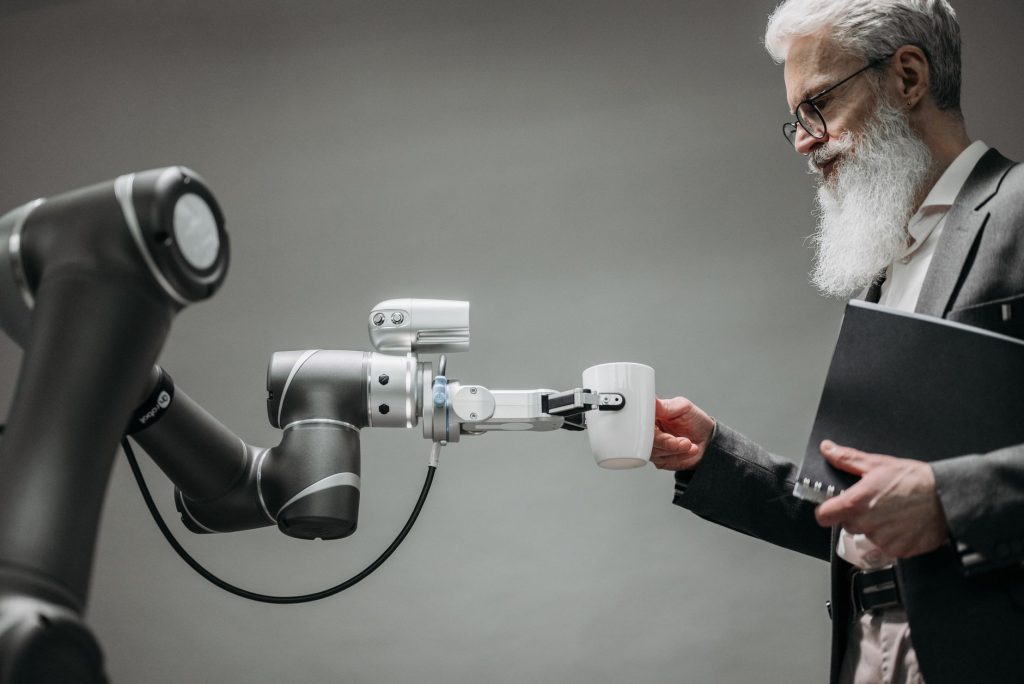
The appeal of Digit stems from its ability to augment human labor rather than merely replace it. In an era of persistent labor shortages, particularly in blue-collar roles that demand physical exertion and precise manipulation, intelligent robots offer a compelling solution. Digit can work alongside human colleagues, handling the physically demanding aspects of a job, allowing human workers to focus on more complex decision-making, supervision, or customer-facing roles. This symbiotic relationship is crucial for palatable adoption, addressing both economic imperatives and societal concerns about job displacement.
The AI Core: From Chatbots to World Models in Physical Space
Beneath Digit’s articulated limbs and sensors lies a sophisticated artificial intelligence engine. This isn’t the AI of chatbots and large language models that have dominated recent headlines; it’s an AI that operates within the constraints and complexities of the physical world. The shift from text-based AI to systems capable of understanding and interacting with spatial and temporal structures, often referred to as “world models,” is precisely what enables robots like Digit to function effectively.
For Digit, this means having the capacity to perceive its environment in real-time, construct an internal representation of that “world,” predict how objects and other agents (including humans) might move, and then plan its own actions accordingly. This involves a confluence of advanced AI techniques:
- Computer Vision: To interpret sensor data, identify objects, and understand spatial relationships.
- Reinforcement Learning: To learn optimal behaviors through trial and error, adapting to new situations and refining its movements.
- Motion Planning and Control: To execute complex bipedal gaits and manipulate objects with precision and balance, even on uneven surfaces.
- Human-Robot Interaction: To safely and effectively collaborate with human co-workers, understanding their movements and intentions.
The development of robust world models is paramount for the next generation of robotics. It allows a robot to generalize its learning, meaning it doesn’t need to be explicitly programmed for every single scenario. Instead, it learns the underlying physics and dynamics of its environment, enabling it to navigate unforeseen obstacles, adapt to changing layouts, and perform tasks it hasn’t been specifically trained for, provided the context is similar. This capability is what truly differentiates advanced humanoid robots from simpler industrial automation, pushing them beyond caged operations into open, human-populated spaces. The deep tech and advanced research behind these capabilities are what make Agility Robotics a truly disruptive player.
A Competitive Landscape and the Road Ahead
Agility Robotics is not alone in its pursuit of humanoid automation. The field is attracting significant investment and innovation, driven by factors like declining sensor and compute costs, advancements in battery technology, and, critically, breakthroughs in AI. Companies like Boston Dynamics, known for its agile Spot quadruped and the Atlas humanoid, have pushed the boundaries of robot mobility, while others focus on dexterous manipulation or social interaction. However, Agility Robotics’ strategic focus on a bipedal form factor for industrial logistics, coupled with its robust AI, positions it uniquely.
The path to widespread adoption for humanoid robots is still fraught with challenges. High upfront costs, the complexity of integration into existing infrastructure, and the need for ongoing maintenance and software updates are significant hurdles. Regulatory frameworks are still evolving to address the safety and ethical implications of intelligent machines operating alongside humans. Public perception, often shaped by science fiction, also plays a role, necessitating careful communication about the benefits and limitations of these technologies.
Yet, the macro trends are undeniable. Global labor shortages, particularly in physically demanding sectors, are only intensifying. The demand for increased efficiency, resilience in supply chains, and the ability to scale operations rapidly are driving businesses to explore advanced automation. India, with its ambitious manufacturing goals under initiatives like “Make in India” and its rapidly expanding logistics sector, stands to be a significant market for such technologies. As Indian enterprises increasingly adopt advanced manufacturing techniques and invest in modernizing their supply chains, intelligent automation, including humanoid robots, could play a crucial role in enhancing productivity and competitiveness. Furthermore, India’s burgeoning deep tech ecosystem, with its strong talent pool in AI and robotics research, could well contribute to further innovations in this space, both as adopters and developers.
The Long-Term Vision: A Collaborative Future
Agility Robotics’ public offering marks a critical inflection point, moving humanoid robotics from the realm of speculative research into a tangible, investable industry. The $2.5 billion valuation is not merely a reflection of current deployments but a powerful statement about the perceived future value of intelligent, mobile, and adaptable robots. It signals confidence that these machines will become an integral part of our industrial, and eventually, perhaps even our daily lives.
The future envisioned by Agility Robotics and its peers is not one of human displacement, but rather one of enhanced human capability. By taking on the dull, dirty, and dangerous tasks, robots like Digit can free up human workers to engage in more creative, strategic, and fulfilling endeavors. This collaborative future, underpinned by advanced AI that understands and navigates our complex physical world, promises not just efficiency gains but a fundamental reshaping of how work is done, ushering in an era where humans and intelligent machines truly co-exist and co-create value. The investment community, through this landmark IPO, is clearly betting that this future is not just inevitable, but imminent.