Nine months ago, SareeViz had no paying customers. Today it has more than 5,000 sellers on the platform and a revenue run rate of ₹60 lakh after 9 months of launch. The founder behind this AI fashion photography platform, Rushabh Agarwal, built the entire product alone. No co-founder handling engineering, no hired developers. He wrote the app using Claude Code, and spent the rest of his time on something most AI founders skip: weeks inside a photo studio, watching how ethnic wear actually gets shot for a catalogue.
From the Family Loom to a Laptop
Agarwal’s family runs a textile weaving business. That’s where the company comes from. Most AI photography tools are built by people who have never sold a garment online. Agarwal grew up next to people who do it every day, and the gap he kept seeing was simple: a seller finishes a run of sarees, and then has to turn each one into a photo good enough for WhatsApp, Meesho, or a printed catalogue, usually by evening, usually without a studio.
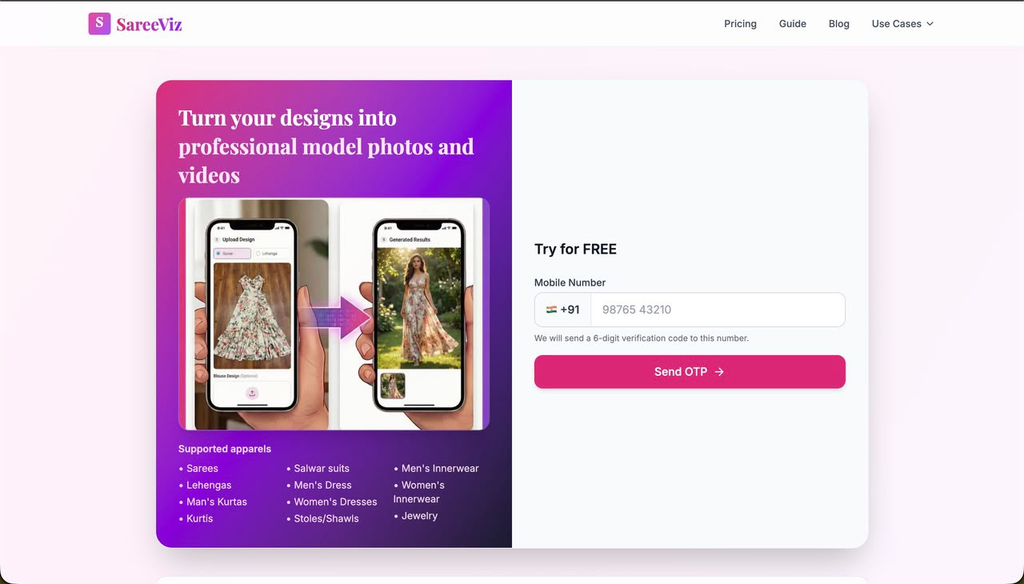
That is the job SareeViz does. A seller uploads a photo of the fabric, sometimes flat, sometimes worn once for reference, and the platform generates model photography and short videos for ecommerce listings, WhatsApp catalogues, and print. No shoot, no model booking, no waiting on a studio slot. That studio research is also why the product is built for speed. SareeViz’s own site promises a finished catalogue image in about a minute, not a multi-day shoot.
What SareeViz’s AI Fashion Photography Platform Actually Solves
Here’s the part most competitors miss. A saree is not one garment. According to SareeViz’s own analysis of over 200,000 catalogue images, 69.2% of saree jobs on the platform include a blouse uploaded as a separate file. Sellers do this because that’s how a saree actually arrives: six metres of fabric plus a blouse piece, often unstitched, often in a contrasting material. A generic AI photography tool sees one image and one garment. It has no idea a second file belongs to the same outfit.
Agarwal built SareeViz around that reality. The platform treats the saree and the blouse as one outfit, matches them for colour and fabric, and drapes both onto a model in a single generation. That’s the proprietary piece: flows built specifically to understand how Indian garments are worn, not a general image model with an ethnic-wear filter on top. It’s also why Agarwal says SareeViz’s draping accuracy on sarees, lehengas, and salwar suits stays ahead of AI tools built for Western apparel.
The Numbers Behind Nine Months
The same data set that surfaced the blouse insight shows something else: who SareeViz’s real customers are. Among 2,741 sellers active on the platform between January and August 2026, just 44 of them, under 2% of the base, generated 77% of all images. These aren’t boutiques listing a handful of designs. They’re manufacturers and wholesalers pushing hundreds of designs a season, for whom catalogue photography is a recurring cost, not a one-off shoot. That 2,741 figure was a snapshot from an eight-month window; SareeViz’s total user base has since crossed 5,000, which tracks with a product that heavy users keep returning to rather than trying once and dropping.
That distinction matters for anyone sizing this business. A tool used by a small number of high-volume manufacturers scales differently than one used by thousands of casual hobbyists. It behaves more like B2B software with a large free-tier funnel on top. For a solo-built AI fashion photography platform nine months old, a ₹60 lakh run rate on that kind of usage pattern is a meaningful signal, not a vanity number.
What’s Next: Making AI Talk to the Loom
Agarwal isn’t stopping at photography. He’s now researching a harder problem further up the textile supply chain: generating designs that a weaving or printing machine can actually run. The catch is that these machines don’t accept a JPEG or PNG. They need binary format files carrying the weaving or printing instructions themselves, the pattern encoded as machine data, not as a picture of a pattern.
That’s a fundamentally different problem than photography. Getting an AI model to produce a design that looks correct on screen is one thing. Getting it to produce a file a jacquard loom or a digital printer can execute without a human translating it first is a manufacturing problem. Few AI startups working in fashion have the domain access to even attempt it. Agarwal has it because his family has been running looms for years.
Why This Bet Matters for India’s $350 Billion Textile Push
India’s textile industry crossed $190 billion in 2025-26, and the government’s own target puts it at $350 billion by 2030. Almost none of that growth shows up as venture-backed software. It shows up as millions of MSMEs, weavers, and traders who still run their businesses on WhatsApp groups and physical catalogues. SareeViz is a bet that the software layer for that specific, unglamorous, enormous market gets built by someone who grew up inside it, not by a generalist AI company that discovers ethnic wear as a use case six months into fundraising.
Solo-founder AI companies get built fast these days. What’s harder to fake is founder-market fit this exact. Agarwal isn’t guessing what a saree seller needs on a Tuesday evening before a WhatsApp catalogue goes out. He grew up watching someone do it.
Trending : https://launch91.com/policy/lt-modular-infra-startup-impact/