A patient in an Indian private hospital can be medically fit to go home by noon and still be sitting in a ward at 4 pm. The usual culprit is a discharge summary that a resident has to type from scattered case sheets, and an insurance file the TPA desk cannot send until that summary exists.
Deepaarogya AI is building AI hospital software aimed squarely at that gap. Founder Abhishek Pandey says the company’s discharge and insurance-ready summary module produces a draft in 2 to 3 minutes, against the 30 to 40 minutes the task usually takes by hand.
What Deepaarogya’s AI hospital software does
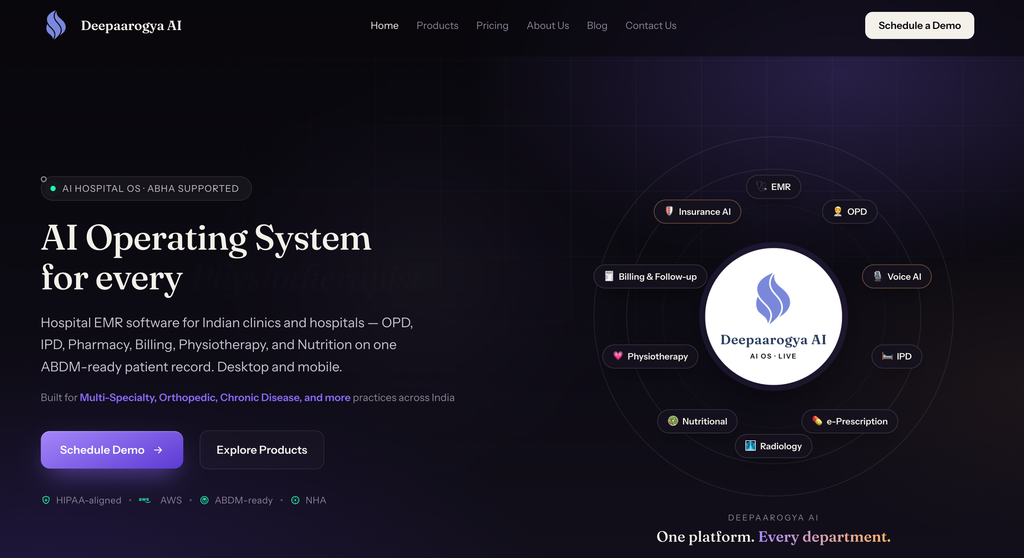
Deepaarogya describes its product as a hospital operating system for Indian clinics. It puts OPD, IPD, pharmacy, billing, physiotherapy, nutrition and clinical AI agents on one shared patient record, according to the company’s website.
The discharge summary agent
The headline feature reads from IPD case sheets, doctors’ orders, nursing notes, vitals and procedure lists. It then assembles a structured discharge summary for the treating doctor to review and sign.
The same pass produces ICD codes and an insurance summary, and flags billable items that might otherwise be missed. The company says this lifts claim approval rates, because files reach insurers complete and consistent.
An AI scribe that speaks the patient’s language
Deepaarogya’s AI scribe listens to the doctor-patient conversation and converts it into SOAP notes (subjective, objective, assessment, plan). The founder says it supports more than 22 Indian languages.
For a country where a single OPD can switch between Hindi, Tamil and English in an hour, that matters. Doctors also get one-click prescriptions from custom templates, and every field in the system can be configured by department.
Built for specialty workflows
The company’s published material shows specialty depth beyond general medicine. Its eye-hospital workflow, for instance, covers cataract evaluation templates, glaucoma monitoring, retina examinations, OCT and fundus imaging integration, and OT scheduling for cataract and LASIK surgery.
Why AI hospital software matters in India now
Two policy shifts have turned hospital paperwork from a back-office irritant into a front-line problem.
The first is insurance. Under its May 2024 master circular, the insurance regulator IRDAI asked insurers to decide on cashless authorisation within one hour and to approve final discharge within three hours of the hospital’s request. That clock only helps the patient if the hospital can produce a clean discharge file quickly.
The second is digital records. The Ayushman Bharat Digital Mission has created more than 90 crore ABHA health IDs and, by mid-2026, linked over 100 crore health records to them. Hospitals that still run on paper or disconnected spreadsheets will find it harder to plug into that network.
Deepaarogya positions its record as ABDM-ready. Its pitch is that a small or mid-sized hospital can adopt one AI hospital software stack instead of buying separate tools for EMR, billing and claims.
Traction and proof points for the AI hospital software
Deepaarogya is bootstrapped and at the early revenue stage, according to its Launch91 submission. The company says it is incubated at the IIT Madras Incubation Cell and at TIDES, IIT Roorkee’s technology incubator.
Its product is live, with a self-serve trial and demo bookings available on the website. The company’s blog shows a steady cadence of specialty workflows through 2026, from eye hospitals to orthopaedics and physiotherapy-linked care.
The next proof points to watch are a disclosed count of hospitals on the platform and an independent measure of claim approval rates before and after adoption.
The founder behind Deepaarogya AI
Abhishek Pandey leads the company and writes much of its product thinking publicly on the Deepaarogya blog. His framing is practical: doctors should spend their time on patients, and software should absorb the typing.
That focus shows in how the AI hospital software is designed. The discharge agent drafts and the doctor approves, so clinical accountability stays where it belongs. Configurable fields mean a cardiology ward and a physiotherapy unit can use the same system without forcing one template on both.
Why investors should watch Deepaarogya
The timing trigger. IRDAI’s discharge timelines put a hard clock on hospital documentation. ABDM gives every Indian hospital a reason to digitise records in a standard format. Both push mid-market hospitals toward software they have long deferred.
The wedge. Many hospital information systems in India were built for billing first. Deepaarogya leads with the most painful clinical task, the discharge summary, and ties it directly to cash flow through faster, cleaner claims. That is an easier sale to a hospital owner than a generic EMR upgrade.
The business model. Deepaarogya sells B2B to hospitals and clinics. A platform that starts with discharge and documentation can expand into pharmacy, billing and revenue intelligence within the same account, which raises revenue per hospital over time.
Capital efficiency. The company has reached early revenue without outside funding, backed by two IIT incubators. For an early-stage investor, that means a working product and real users before the first institutional cheque.
The milestone that de-risks it. The next signal is a published cohort of hospitals showing discharge turnaround time and claim approval rates over six months. With that data, this AI hospital software has a clear case for a seed round and a faster sales motion across tier-2 and tier-3 cities.
The bigger opportunity
India’s hospitals are being asked to move faster on discharge, cleaner on claims and fully digital on records, all at once. Most of them cannot hire their way to that standard.
Deepaarogya is betting that a doctor-first, multilingual AI hospital software layer can let a 50-bed hospital in a smaller city meet the same bar as a metro chain. If the claim numbers hold up at scale, Abhishek Pandey’s company could become the default operating system for the hospitals that need it most.
Readers following Indian B2B AI can also see how Jifwa is applying AI to contract execution for MSMEs and how Dhiway is building verifiable credentials for trusted data exchange.
FAQ
What is Deepaarogya AI hospital software?
Deepaarogya AI is an Indian startup building AI hospital software. It combines EMR, OPD, IPD, pharmacy, billing and AI agents for discharge summaries and clinical notes on one ABDM-ready record.
How fast does Deepaarogya generate a discharge summary?
The company says its discharge and insurance-ready summary takes 2 to 3 minutes, compared with 30 to 40 minutes when prepared manually. A doctor reviews each draft before it is finalised.
Which languages does the Deepaarogya AI scribe support?
According to the founder, the AI scribe converts doctor-patient conversations into SOAP notes in more than 22 Indian languages.