Picture a vessel 11 metres long and 2 metres wide, weighing about 20 tonnes. It slips below the surface and holds three knots for weeks. When its batteries run low, it surfaces on its own, runs a diesel generator to recharge, and dives again. It reports to shore over satellite. Nobody is inside.
That is Jalkapi, the autonomous submarine Bengaluru-based Rekise Marine is building for the Indian Navy. The company calls it India’s first extra-large autonomous underwater vehicle (XLAUV), designed to stay at sea for 30 to 45 days.
In June 2026, Rekise raised a $9.7 million seed round co-led by Accel and NKSquared, the investment firm of Zerodha co-founder Nikhil Kamath, as the Economic Times reported. The money has one headline job. Put Jalkapi in the water.
Why the Indian Navy wants an autonomous submarine now
Crewed submarines take years to build and need dozens of trained sailors aboard. Some missions need neither. Long surveillance patrols, seabed mapping and mine hunting reward endurance more than human presence.
The Navy has been planning for this shift since October 2021, when Defence Minister Rajnath Singh launched the Integrated Unmanned Roadmap for the Indian Navy. It will guide how the force develops and inducts unmanned systems until 2030. In 2025, the Navy issued an expression of interest for a dozen extra-large unmanned underwater vehicles for anti-submarine warfare, mine countermeasures and surveillance, with missions of up to two months, the Free Press Journal reported.
Funding routes followed the plan. The Ministry of Defence’s ADITI scheme, run through iDEX, offers grants of up to ₹25 crore per project for critical defence technologies, covering up to half the development budget. In August 2024, Rekise won the Navy’s iDEX ADITI 1.0 challenge to develop Jalkapi, as iDRW reported. It is finalising the design with the Navy’s Directorate of Naval Design.
Inside Jalkapi, Rekise’s autonomous submarine
Jalkapi runs on lithium-ion batteries backed by an onboard diesel generator. The autonomous submarine decides when to surface and recharge, then returns to depth without a crew member making the call. It is rated to 300 metres, cruises at three knots and can push to eight.
Its sensor fit reads like a small warship’s. Forward-looking sonar, a multibeam echosounder, radar and electronic support measures, electro-optical and infrared cameras, and an inertial navigation system aided by a Doppler velocity log and acoustic positioning. Collision avoidance follows COLREGS, the international rules of the road at sea. Rekise lists its roles as surveillance, covert patrol, anti-submarine warfare, seabed mapping and mine countermeasures.
One autonomy stack, from 55 kg to 20 tonnes
Jalkapi is the flagship. It isn’t the whole fleet.
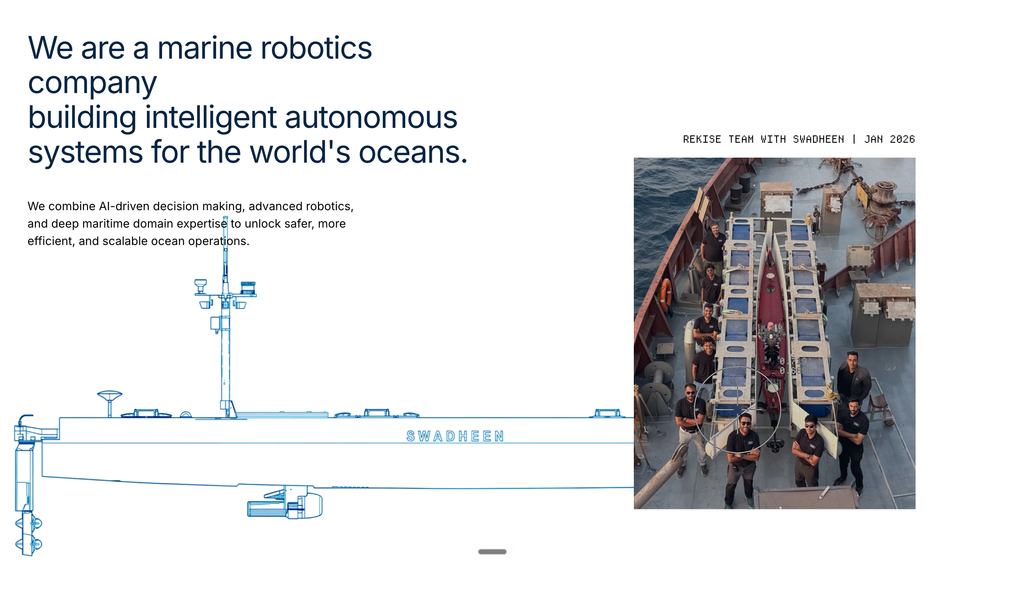
Jaldoot, a 1.6-metre surface vessel weighing about 55 kg, handles harbour and inland surveys and has already been delivered to customers. Swadheen, a 5-metre survey vessel with full dynamic positioning and redundant propulsion, has completed fully autonomous open-sea trials. A man-portable underwater vehicle rated to 100 metres, light enough for one operator to launch without a support ship, is in trials now.
All of them run the same autonomy software with minimal reconfiguration, according to YourStory. The founders explain the design logic in one line: “the autonomy is only as good as the sensors and hardware feeding it.” So Rekise designs hull, sensors and software as one system, and builds with shipyard partners Goa Shipyard Limited and GRSE.
Why the small boats matter to the big one
Every hour Jaldoot and Swadheen spend at sea tests the navigation, perception and fault-recovery code the autonomous submarine will depend on. In my read, that is Rekise’s quiet advantage. A team building one large prototype would debug its autonomy on its most expensive hardware. Rekise debugs it on a 55 kg boat first.
A naval architect and a retired rear admiral
Rekise was founded in 2017 by Maitrai Maka, a naval architect who serves as founder and CEO, and Rear Admiral Shekhar Mital (Retd), co-founder and executive director.
The pairing fits the problem. Defence hardware fails when engineers build what they assume the user wants. A founder who designs hulls, working beside a flag officer who knows how the Navy plans and buys, closes that gap early. Nine years of building before a large round also shows a team willing to work at the pace defence procurement sets.
The $9.7 million seed round
Accel and NKSquared co-led the June 2026 round. Sameer Brij Verma, Sandeep Singhal, Industrial47, Singularity AMC, the founders and several family offices also came in. Rekise says the capital will complete Jalkapi, its autonomous submarine, and take it through sea trials, deepen the autonomy software and grow engineering teams across robotics, AI and machine learning, embedded systems, systems integration and naval architecture.
Kamath framed his bet around India’s long record of building warships and submarines. Maritime autonomy, he argued, is the capability the country now needs to own.
Why investors should watch Rekise Marine
The timing trigger is demand the Navy has already put on paper. A published unmanned roadmap, an expression of interest for twelve extra-large unmanned underwater vehicles and a ₹750 crore ADITI scheme all point the same way. The Navy is buying from startups too. In April 2026, Odisha’s Coratia Technologies signed a ₹66 crore contract for underwater robots, Telangana Today reported.
Rekise’s wedge is size. Much of India’s marine robotics activity sits in remotely operated vehicles and small surface craft. Rekise is building an autonomous submarine at the extra-large end under an iDEX ADITI programme, and backs it with a working fleet already at sea.
The model is B2G first. Platforms sell to the Navy and defence shipyards, while survey vessels such as Jaldoot and Swadheen open hydrographic and environmental work that can earn revenue as Jalkapi matures.
Three milestones will de-risk the story. The autonomous submarine completing sea trials. The development programme converting into a production order against the Navy’s extra-large requirement. And the man-portable vehicle moving from trials to a first order.
The navy India builds next
Navies everywhere are working out how many hulls they need with nobody aboard. India’s answer will come from teams that can build the whole stack at home, and Rekise already spans a 55 kg survey boat to a 20-tonne autonomous submarine. If Jalkapi’s sea trials go to plan, India’s next submarine programme won’t start with a crew list.
Frequently asked questions
What is Rekise Marine?
Rekise Marine is a Bengaluru-based marine robotics company, founded in 2017, that builds autonomous surface vessels and underwater vehicles for defence and survey work.
What is Jalkapi?
Jalkapi is an autonomous submarine Rekise Marine is developing for the Indian Navy under the iDEX ADITI programme. It is 11 metres long, dives to 300 metres and is designed for missions of 30 to 45 days.
Who invested in Rekise Marine?
Accel and NKSquared co-led its $9.7 million seed round in June 2026, with Industrial47, Singularity AMC, angel investors and family offices participating.
Related : https://launch91.com/startups/low-carbon-concrete-navozzo/