A cubic metre of ready-mix concrete is mostly stone, sand and water. Nearly all of its carbon comes from one ingredient, the cement. Add more of it and the emissions climb with it.
Udaipur-based Navozzo Materials is going after that one ingredient. The startup turns mining waste into additives for low-carbon concrete, and it says 5 kg of its product lets a ready-mix (RMC) plant drop 40 to 50 kg of cement from each cubic metre. By the company’s numbers, that avoids about 31 to 39 kg of CO₂ per cubic metre and cuts input cost by ₹50 to ₹125. The concrete specification stays the same.
That last detail is what turns low-carbon concrete from a sustainability line item into a purchasing decision. The plant pays less and emits less in the same pour.
Why cement content decides concrete’s carbon
Cement carries a heavy footprint because of clinker, limestone fired in a kiln at very high heat. India’s cement industry emits about 0.67 to 0.68 tonnes of CO₂ per tonne of cement, above the global average of 0.58, according to Chemistry World.
That carbon now has a compliance cost. On 8 October 2025, the government notified the Greenhouse Gases Emission Intensity Target Rules, which make cement plants cut CO₂ per tonne of output against a 2023-24 baseline. The first cycle asks for about a 3.4% cut over two years, as CemNet reported.
RMC is where those tonnes get poured. India’s ready-mix market stood at about 249 million cubic metres in 2025 and is forecast to reach 371 million by 2031, according to Mordor Intelligence. At that volume, low-carbon concrete is a question of grams per cubic metre, and every kilogram of cement removed counts.
How Navozzo makes low-carbon concrete from mining waste
Navozzo starts with mining waste that would otherwise end up in a landfill. It grinds the material, classifies it by particle size and treats it with patented proprietary activators. The result is a family of fine mineral additives that go into the mix alongside cement and let a plant use less of it.
Feedstock is not the constraint. Marble processing units in Rajasthan alone generate 5 to 6 million tonnes of slurry a year, according to Central Pollution Control Board guidelines, and much of it is dumped on open land. Mining waste is one of the few industrial inputs India has in surplus.
Four products for low-carbon concrete
NavoEdge is the flagship, built for the M25 to M45 grades used in slabs, beams and columns. It is dosed at 1 to 2% of cementitious mass and conforms to ASTM C1797, the US specification for mineral fillers in concrete.
Navosil HG targets M50 and higher grades, replacing micro silica in bridges, tunnels, high-rises and marine piling. Ultrafine Navoash is positioned against ultrafine GGBFS. Navolve, a supplementary cementitious material that conforms to ASTM C618, replaces part of the OPC in a mix.
The import angle gives the range its edge. Silica fume and ultrafine slag sit at the premium end of the additive shelf, and the company says RMC producers often source them from abroad. Navozzo makes its versions in India and says they cost less with comparable performance data. Its products have been tested at IIT Jodhpur, according to the company.
Traction: low-carbon concrete that pays for itself
Navozzo is early and already earning revenue. Its additives have gone into about 2,300 cubic metres of concrete so far, abating roughly 90 tonnes of CO₂, the company says. That works out to about 39 kg per cubic metre, at the top of its stated range.
The scale maths is the real pitch. A typical RMC plant produces 2 to 5 lakh cubic metres a year, according to IMARC Group. At 1,00,000 cubic metres, under half of one plant’s yearly output, Navozzo’s ratio adds up to about 3,100 to 3,900 tonnes of CO₂ avoided and ₹50 lakh to ₹1.25 crore saved on inputs.
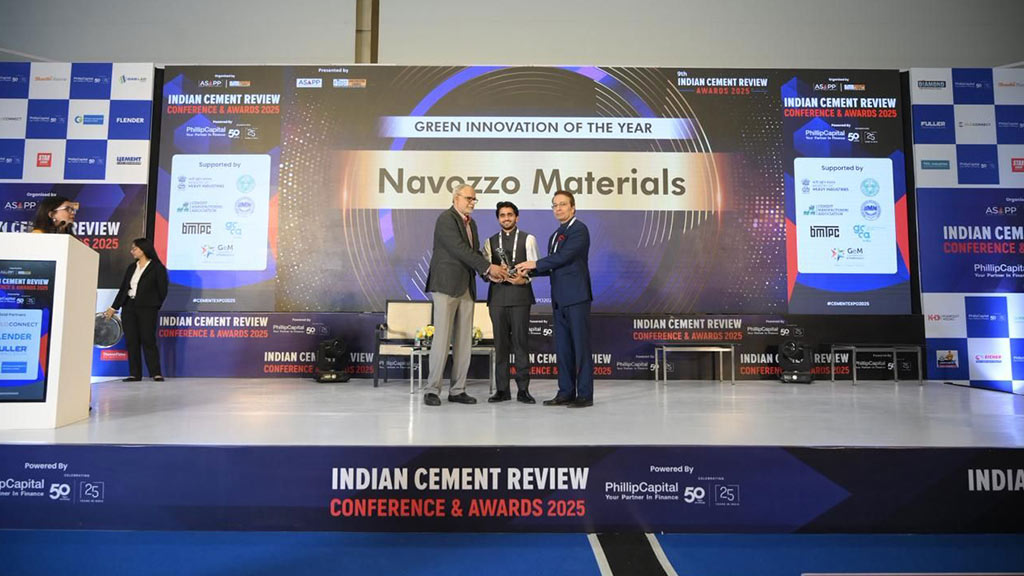
The company has been making its technical case for low-carbon concrete in the trade press too. Buildcon Media’s Building and Construction Update magazine published Navozzo articles on NavoEdge in April 2026 and on Navosil HG in June 2026. Navozzo also received recognition at the Indian Cement Review Awards 2025.
The founders and a decade of materials research
Navozzo Materials was incorporated in March 2025 and is bootstrapped. Its founders are Utkarsh Baxi, Mihir Kothari, Dr. Ramkumar Natarajan and Deepak Parihar.
The company is the newest in a Udaipur group of materials ventures that began with Ecomaterials India LLP in 2012, making eco-friendly plasters. Later entities worked on cement-free binders and on fly ash and steel slag as cement alternatives. In 2024, the group launched Navocem for clinker-free cement. Dr. Ramkumar holds a doctorate in materials engineering from the University of Illinois Chicago and multiple patents on making cement from industrial waste.
Navozzo takes that research to a faster-moving buyer, the batching plant that reorders additives every week.
Why investors should watch Navozzo
The timing trigger is regulation. Cement now has binding emission-intensity targets, and developers on large projects increasingly ask for low-carbon concrete in their tenders. Navozzo meets that demand without a green premium.
The wedge is the dose ratio. A 5 kg dose that displaces 40 to 50 kg of cement costs less than what it removes, so the saving pays for adoption. A plant keeps its specification and its equipment. Switching takes a trial mix, not capital.
The business model is a B2B consumable sold by the tonne to RMC producers and precast makers that need low-carbon concrete at a normal price. Revenue tracks cubic metres poured, and every plant that switches its input stack becomes repeat volume.
The next proof points are clear. Watch for the IIT Jodhpur mix data published with strength results at 7 and 28 days, a multi-plant RMC chain adopting NavoEdge as a standard input, and dedicated processing capacity to serve that demand.
The bigger opportunity
India will pour hundreds of millions of cubic metres of concrete a year through this decade. Most ways of cutting cement’s carbon add cost. Navozzo’s bet is that the cheapest input at the batching plant can also be the cleanest one, made from waste the mining belt already has in surplus. If its ratio holds across hundreds of plants, low-carbon concrete becomes the default because it is cheaper.
Frequently asked questions
What does Navozzo Materials make?
Navozzo Materials is an Udaipur startup that processes mining waste into additives and microfine materials for low-carbon concrete, including NavoEdge, Navosil HG, Ultrafine Navoash and Navolve.
How does NavoEdge help produce low-carbon concrete?
The company says 5 kg of its additive lets a plant remove 40 to 50 kg of cement per cubic metre, avoiding about 31 to 39 kg of CO₂ without changing the concrete specification.
Which standards do Navozzo’s products meet?
NavoEdge and Navosil HG conform to ASTM C1797, and Navolve conforms to ASTM C618. The company says its products were tested at IIT Jodhpur.
Related : https://launch91.com/startups/clinker-free-cement-navocem/