A tonne of ordinary Portland cement leaves roughly 830 kg of CO₂ behind it, by Navocem’s estimate. Regulators land in the same zone. The US Environmental Protection Agency’s benchmark puts the median cement plant at about 776 kg of CO₂ per tonne of cement.
Navocem’s binder comes in at 150 to 200 kg. No kiln is ever lit to make it.
The Udaipur company, incorporated as Navocem Infra Industries in May 2024, makes clinker-free cement for India’s builders. The carbon number is only half the pitch. At 28 days its cement reaches 47.5 MPa, against the 43 MPa minimum that OPC 43, India’s workhorse grade, has to clear, and it sells at a comparable price.
That combination is rare. Most low-carbon building materials ask the buyer to pay more or accept less. Navocem asks for neither.
Why India needs clinker-free cement now
Cement accounts for around 8% of global CO₂ emissions, according to Chatham House. Most of that comes from clinker. Limestone is heated in a kiln to about 1,450°C, and the chemistry of that reaction releases CO₂ on top of the fuel burned to reach the heat.
Indian demand is still climbing. Per capita consumption sits at about 300 kg against a global average of 540 kg, by Navocem’s reading, so most of the country’s cement is still to be poured. And those emissions now carry legal weight. On 8 October 2025, the government notified binding greenhouse gas intensity targets for 282 plants across cement, aluminium, chlor-alkali and pulp and paper, as the International Carbon Action Partnership reported. Miss the target and the plant buys carbon credits.
Blended cements already hold about 70% of the Indian market, so builders are used to slag in the bag. Blending trims the clinker share. Only clinker-free cement takes it to zero.
How Navocem makes cement without a kiln
Navocem’s binder is 90 to 94% industrial byproducts, mostly ground granulated blast furnace slag from integrated steel plants. Slag alone hardens slowly, so the company adds a proprietary alkali-based activator that starts the binding reaction chemically instead of thermally. In May 2026, CemNet’s International Cement Review reported a patent grant for the technology.
Supply is not the constraint. The company counts 44.47 Mta of slag capacity in India, concentrated in Odisha, Jharkhand, Karnataka and Chhattisgarh. Europe plans to retire 24 of its 47 blast furnaces by 2035. India is going the other way.
A cement plant that fits in a grinding unit
The plant economics are the part investors should sit with. Alkali activation runs on grinding equipment, not kilns, so clinker-free cement can be made in ball mills and vertical roller mills already installed worldwide. Navocem puts the capital saving against a conventional cement plant at roughly 70%, and says commissioning arrives six years sooner.
Navocem Green Cement is sold as an OPC 43 equivalent for slabs, beams, columns and ready-mix. Two slag products sit alongside it, GGBS+ and Ultrafine GGBS+, the latter aimed at M50 and higher concrete.
The proof behind the clinker-free cement claim
Strength is the first question a structural engineer asks. Navocem’s numbers clear IS 269 thresholds for OPC 43 at every age: 30 MPa at three days against 23 required, 38 at seven days against 33, and 47.5 at 28 days against 43. Testing was done at NABL-accredited laboratories including Bureau Veritas, and the company says IIT Jodhpur has also validated the product.
Durability is where slag binders usually win. Carbonation depth stays under 5 mm at 90 days, which suits the extreme exposure class in IS 456, and alkali-silica expansion holds under 0.04% at 28 days, inside the 0.10% innocuous limit.
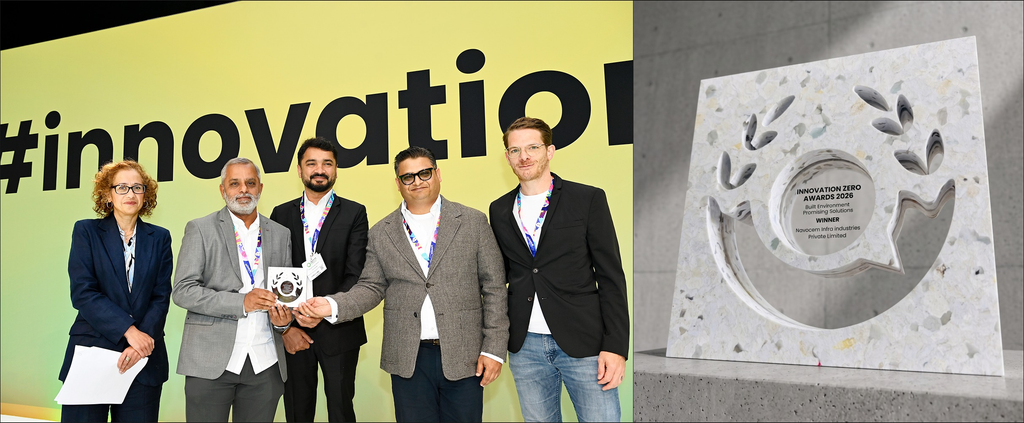
The technology sits at TRL 7, demonstrated in an operational setting, with trials running at 1,000 tonnes a month and early revenue coming in. Navocem also won the Built Environment category of the Innovation Zero Award 2026 and took Special Jury Recognition at the Indian Cement Review Awards 2025.
The standards question, and the answer in progress
Here is the constraint, and the company states it plainly. The Bureau of Indian Standards has no specification yet for clinker-free cement in structural use. What exists is IS 17452:2020, covering alkali-activated concrete for precast products, and Navocem conforms to it along with the American standard ASTM C1157.
So the near-term market is precast and non-structural work, which is where the pilot plant is aimed. Navocem has applied to BIS for a structural standard and expects six to twelve months. That approval is the single event that would open structural concrete and government tenders.
A decade of materials research behind the product
Navocem’s roots go back further than 2024. Its group starts with Ecomaterials India LLP, set up in 2012 to make eco-friendly plasters, followed by companies working on cement-free binders and slag-based alternatives in 2018.
Co-founder Dr. Ramkumar holds a doctorate in materials engineering from the University of Illinois Chicago, did post-doctoral research at Argonne National Laboratory, and holds multiple patents on making cement from industrial waste. Mihir Kothari is part of the leadership team taking the product to builders. The company is bootstrapped.
Cement is a conservative category. A decade of formulation work is what earns a newcomer the right to ask.
Why investors should watch Navocem
The timing trigger is regulation. Compliance targets now price every excess tonne of CO₂ a cement plant emits, and India has committed to net zero by 2070.
The wedge is that Navocem does not ask for a green premium. Research cited by the company suggests Indian buyers will absorb 5 to 10% more for green materials, and up to 15% on LEED-certified commercial projects. Selling at OPC 43 prices means Navocem never has to spend that goodwill, which in my read matters more than the carbon number in a market this price-sensitive.
The scale-up plan is staged rather than heroic. A 0.18 Mta pilot plant is planned for FY27-28, aimed at captive and precast demand, followed by expansion toward 2 Mta through satellite grinding units in Chhattisgarh, West Bengal, Odisha and Jharkhand, each sited next to its slag supply.
Three markers will tell the story. BIS approval of clinker-free cement for structural use. The pilot plant reaching commissioning on budget. And a named precast or infrastructure buyer placing a repeat order.
The bigger opportunity
For a century, the kiln has been the price of entry to the cement business. Navocem is betting India can build its next decade of roads, homes and metro lines on slag and chemistry instead, at the same price and a fraction of the carbon. If clinker-free cement keeps matching OPC on site, the cheapest way to build in India will also be the lowest-carbon one.
Frequently asked questions
What is clinker-free cement?
Clinker-free cement is a binder made without Portland clinker, the kiln-fired ingredient behind most of cement’s CO₂. Navocem makes its clinker-free cement from blast furnace slag and a proprietary alkali activator.
How strong is Navocem’s cement?
Navocem reports 47.5 MPa at 28 days, above the 43 MPa minimum for OPC 43. Testing was done at NABL-accredited laboratories including Bureau Veritas.
Is clinker-free cement approved for use in India?
IS 17452:2020 permits alkali-activated concrete in precast products, and Navocem conforms to it. The company has applied to BIS for a standard covering structural use.
Related : https://launch91.com/deep-tech-research/atmospheric-water-generator-akvo/