In 1991, an Indian researcher completed a doctoral thesis on lithium-ion conducting solid electrolytes. Lithium-ion cells had only just reached the market, and the idea of a battery with no liquid inside was a lab curiosity.
Thirty-five years later, Dr. S.R.S. Prabaharan is still working on that problem, and the market has caught up with him. His Chennai startup, Inventus Battery Energy Technologies, is developing Ceramion+™, a flexible oxide ceramic membrane at the core of a lithium-metal solid-state battery for defence, aerospace and electric mobility.
The idea is easy to state and hard to build. Take the flammable liquid out of the cell, put a thin ceramic sheet in its place, and pair it with a lithium-metal anode that holds far more energy than graphite.
Why India needs a safer solid-state battery now
Every conventional lithium-ion cell carries a liquid electrolyte that can burn. India saw what that means in 2022, when a run of electric scooter fires led the Ministry of Road Transport and Highways to commission expert investigations. The ministry then amended the AIS-156 and AIS-038 battery safety standards, effective from December 2022, according to a government reply in the Rajya Sabha.
The second pressure is supply. India approved an ₹18,100 crore PLI scheme for Advanced Chemistry Cell manufacturing in May 2021, aiming for 50 GWh of domestic capacity. By February 2026, 40 GWh had been awarded and about 1 GWh installed, the Ministry of Heavy Industries told Parliament. China produces more than three-quarters of the batteries sold worldwide, the IEA found.
For a country that is behind on today’s cells, the next chemistry is the place to compete. Toyota and Idemitsu are targeting all-solid-state EV batteries for 2027 to 2028, CarNewsChina reported. The race for the solid-state battery is still open.
How the Ceramion+ solid-state battery works
Every solid-state battery design faces a trade-off in its electrolyte. Sulfide materials conduct ions well, but some EV cell designs built on them specify stack pressures of up to 5 MPa to keep layers in contact, per the same CarNewsChina report. Oxide ceramics are chemically stable but brittle, which makes thin, large sheets difficult to produce.
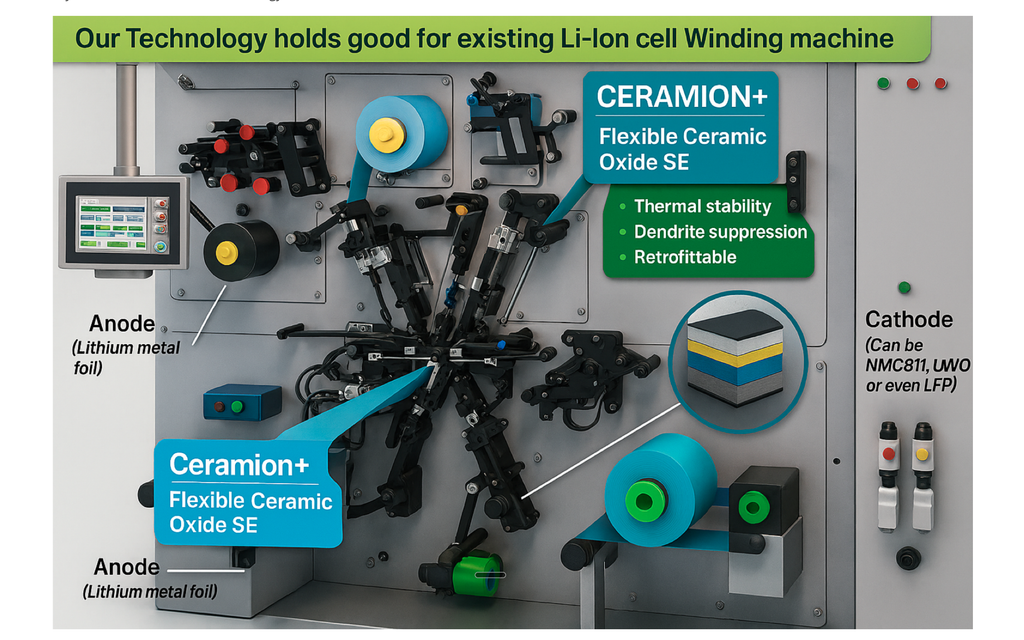
Inventus’s answer is an oxide ceramic that bends. Ceramion+ combines ceramic oxide with a proprietary mechanical stabiliser and is tape-cast into membranes thinner than 50 microns. The process is dry and roll-to-roll, designed to fit the coating and stacking lines lithium-ion factories already run. The company says its cells need no applied stack pressure.
The figures Prabaharan shared in a December 2025 EVreporter interview are company-reported and promising. Ceramion+ shows ionic conductivity above 4 mS/cm at room temperature, close to liquid electrolytes. Its 5.5 Ah pouch prototypes reach about 350 Wh/kg at cell level, and one cell has kept 92.8% of its capacity after 1,000 cycles, with testing ongoing. The cells charge to 80% in under 15 minutes and, in internal tests, did not catch fire at 180°C, under nail penetration or during an external short circuit.
Why the lithium-metal anode matters
Lithium metal has a theoretical capacity of 3,860 mAh/g, roughly ten times that of graphite. The obstacle has always been dendrites, the needle-like growths that can pierce a separator and short a cell. A dense ceramic layer resists them. Inventus holds an Indian patent, IN385777, for a protected lithium-metal anode cassette, along with a published international PCT application.
From prototype to pilot line
Inventus rates Ceramion+ at technology readiness level 7 to 8, with internal validation complete. The next step is third-party testing with accredited laboratories and defence agencies. The roadmap then moves to a pilot stack line for 5 to 20 Ah cells with OEM A-sample trials in early 2027, B-samples for EV and aerospace modules later that year, and a commercial launch through partners in 2028.
Support has come from India’s research system. The National Research Development Corporation, under the Department of Scientific and Industrial Research, backed the solid-state work with a ₹1 crore technology development project, YourStory reported. YourStory also named Inventus to its Tech30 list of promising startups in 2024.
Inventus also sells cathode materials, electrolyte formulation and plant consulting to lithium-ion cell makers, which keeps its team close to the factories it hopes to supply.
The founder who helped start India’s lithium-ion research
Prabaharan’s career runs through the history of Indian battery science. In the early 1990s he worked at CSIR-CECRI in Karaikudi, where, the company says, he began India’s first lithium-ion research. He later became a full professor and head of fuel and energy technology at the University of Nottingham’s Malaysia campus, held roles at VIT and SRM, and published more than 100 papers.
He co-founded Inventus in 2020 while serving as a university’s director of research, then left academia in November 2022 to run it full-time, Outlook Business reported.
His co-founders bring depth on both sides. CTO Dr. Siluvai Michael has spent more than 30 years on electrochemical storage. CFO Cecil Lazarus spent three decades in manufacturing and finance, including stints at HAL and Whirlpool. Dr. J. Malathi is a co-inventor on the Ceramion+ platform. The co-founders have said the hardest step was making the ceramic flexible enough to work as a membrane.
Why investors should watch Inventus
The timing trigger is policy meeting physics. India’s cell manufacturing targets are behind schedule, its safety rules have tightened, and defence and aerospace buyers need batteries that survive heat, cold and impact. A domestic solid-state battery addresses all three.
The wedge is manufacturability. A flexible oxide membrane that runs on existing roll-to-roll lines without stack pressure could let a cell maker add solid-state production without building a new factory. The IP was developed in India, which matters to government and defence buyers.
The business model is hybrid. Inventus plans to manufacture directly for defence, aerospace and specialty electronics, license its electrolyte and stack IP to cell makers, and form joint ventures with OEMs.
Three milestones will de-risk the story. The first is an independent validation report from an accredited lab or defence agency. The second is the pilot stack line coming online. The third is a first A-sample trial of the solid-state battery with a defence, aerospace or EV customer.
The bigger opportunity
India largely imported its way into the lithium-ion era. Inventus is betting the country can invent its way into the next one, starting with a ceramic that bends. If Ceramion+ clears independent testing, the first commercial Indian solid-state battery may come from the researcher who studied the material before most of the industry existed.
Frequently asked questions
What is a solid-state battery?
A solid-state battery replaces the flammable liquid electrolyte in a conventional lithium-ion cell with a solid material, which improves safety and allows lithium-metal anodes for higher energy density.
What is Ceramion+?
Ceramion+™ is a flexible oxide ceramic solid electrolyte membrane developed by Chennai-based Inventus Battery Energy Technologies for lithium-metal solid-state cells.
Who founded Inventus Battery Energy Technologies?
Inventus was co-founded in 2020 by Dr. S.R.S. Prabaharan, who leads it as founder and CEO, with Dr. Siluvai Michael and Cecil Lazarus.
Related : https://launch91.com/startups/verifiable-credentials-dhiway-satish/