India budgeted ₹1.71 lakh crore for fertiliser subsidies in 2026-27, Argus Media reported. Urea alone takes about ₹1.16 lakh crore of that, roughly 68%, according to a policy brief from ICRIER. The Fertiliser Association of India has warned that the price gap between urea and other fertilisers has skewed how farmers apply nitrogen, phosphorus and potassium, as Business Standard reported.
Most of that money lands on fields where nobody has measured what the soil actually needs.
Sensegrass is building soil intelligence for that gap. Founded by Lalit Gautam, the company combines geospatial AI, satellite and remote-sensing data and its own IoT soil sensors in one platform, YieldSync. It shows a grower, an agribusiness or an insurer which part of a field is under stress, what changed in its water or nutrient picture, and what to do next.
Why soil intelligence matters for Indian farms now
Two pressures are meeting on the same field.
The first is input cost. Every bag of fertiliser applied where the crop doesn’t need it is paid for twice, once by the farmer and once by the exchequer.
The second is risk. Claims under PMFBY, India’s crop insurance scheme, have long depended on manual crop-cutting experiments. From Kharif 2023 the government introduced YES-TECH, which blends satellite-based yield estimates with those manual samples, according to a PIB factsheet. Technology-derived yield now carries a mandatory 30% weight, the Minister of State for Agriculture told the Lok Sabha, as ETV Bharat reported.
Both shifts reward one capability. Read a field accurately, from a distance, across thousands of plots. That is the market soil intelligence is built for.
How the Sensegrass soil intelligence platform works
Sensegrass started its soil intelligence work underground. Its first product, the SenseSoil platform, ran on NPK soil sensors the company says are patented, measuring 18 soil and crop parameters to guide water and fertiliser decisions. That hardware gave the team something a satellite-only startup lacks: years of in-field readings to check remote data against.
In 2025 the company launched what it calls SenseGrass V2, rebuilt around GeoAI. YieldSync, the flagship, now brings satellite imagery, weather data and field diagnostics into one dashboard.
AgRI SHIELD AI and 10-metre grids
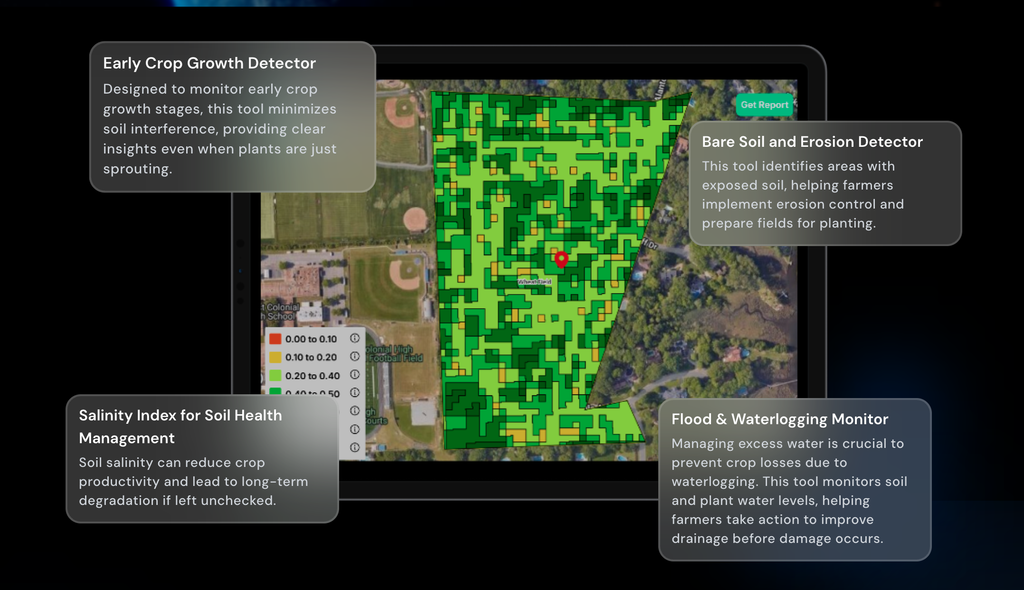
At the core of the soil intelligence stack sits AgRI SHIELD AI. It tracks vegetation, water and temperature anomalies against a field’s own history, then splits the field into 10 m by 10 m grid cells. Each cell gets a heatmap, a performance score and a recommendation. A companion dashboard, FieldSecure, shows NDVI and NDWI time-lapses, rainfall and temperature anomalies, and predicted growth stages.
Dedicated detectors flag weak early germination, soil salinity, bare soil and erosion, and waterlogging. An AI agronomist chatbot answers farmers’ questions. An API lets partners pull YieldSync data into their own systems.
Built for whoever carries the risk
The insurance workflow shows the design thinking. A farmer enters a planting date and a harvest date. Sensegrass builds a season report from satellite and weather data, marking stress events such as heat spells or frost, and the farmer can share it with an insurer in one click. Yield estimates run at two levels, plot-level for growers and regional for insurers and policymakers.
A third module, BiomeSync, estimates soil organic carbon and converts it to CO₂ equivalent using methods the company says follow IPCC Tier 2+ guidance. That is the groundwork for soil carbon credits.
Soil intelligence traction on three continents
Sensegrass has been selling for years, and not only in India. In 2020, MIT Technology Review’s Innovators Under 35 profile reported its products were sold in Chile, parts of Latin America and the United States. By 2021 it had more than 35 clients in India, including agricultural marketplaces and food and agro production companies, and had run a pilot with the agriculture ministry, YourStory reported.
Recognition followed the work. Sensegrass won the India Impact Grand Prize at the Cisco Global Problem Solver Challenge 2020 and joined Cisco LaunchPad. In 2026, Trellis picked it from 105 applicants as one of 15 climate tech startups to watch.
Europe is next. In May 2026, co-founder and COO Ayashi Das Majumder set up the company’s European subsidiary in Vienna through Austria’s GO AUSTRIA programme, Trending Topics reported. She has cited Austria’s data and sustainability rules and its research ecosystem as the draw.
Sensegrass sells B2B, reports early revenue and says it has raised more than $1 million.
A third-generation farmer turned founder
Gautam describes himself as a third-generation farmer. He grew up in a village in Uttar Pradesh, trained in pharmacy (Pharm.D), added an MBA, and says he had built and exited a startup before Sensegrass. He founded the company in 2019. The current leadership includes Saurabh Dixit as VP Engineering and Hem Raj Pandey, a remote-sensing specialist, as VP Data Science and GIS.
The order of operations is what I find most telling. Gautam built hardware first, earned ground truth, then moved to satellite software that costs far less to deliver per new acre. In my read, that sequence is the moat.
Why investors should watch Sensegrass
Timing. YES-TECH’s 30% weight gives insurers and states a reason to pay for defensible, technology-based yield estimates. Fertiliser subsidy reform keeps balanced nutrient use near the top of the policy agenda. In Europe, data and sustainability reporting rules push agrifood buyers toward measurable soil and carbon records.
Wedge. Satellite-only players can map stress. Sensegrass’s soil intelligence ties that map back to what its sensors actually measured in the soil, and that pairing is hard to copy without years in the field.
Model. YieldSync is sold as software and through an API to agribusinesses, insurers and public agencies. Each new region adds training data that sharpens the next one.
Milestones. Watch for a named insurer or state using Sensegrass yield estimates in a YES-TECH season, published accuracy against crop-cutting results, a first paying European customer out of Vienna, and BiomeSync credits issued under a recognised registry.
The bigger opportunity
India’s farm policy is moving from subsidising inputs toward measuring outcomes, and crop insurance is moving with it. Every one of those shifts needs a trusted reading of the field. Sensegrass has spent seven years learning to take that reading, first from inside the soil and now from orbit. If its soil intelligence becomes the record insurers, lenders and governments price against, Sensegrass will sit underneath how farm money moves.
Frequently asked questions
What does Sensegrass do?
Sensegrass is a GeoAI company building soil intelligence for agriculture. Its YieldSync platform combines satellite imagery, weather data and soil sensor readings into field-level maps and recommendations.
Who founded Sensegrass?
Lalit Gautam founded Sensegrass in 2019 and leads it as CEO. Ayashi Das Majumder is co-founder and COO.
How does Sensegrass help with crop insurance?
Sensegrass’s soil intelligence platform lets farmers generate a season report from satellite and weather data and share it with an insurer. The company also offers regional yield estimates for insurers and policymakers.
Related : https://launch91.com/deep-tech-research/solid-state-battery-inventus-ceramion/