Walk through the industrial belt of Coimbatore and you will find hundreds of small machine shops with a lathe running at half pace and a welding bay that sits idle on some afternoons. For an equipment maker in Pune or Chennai, that spare capacity is invisible. For Mountire Machinery and Components, it is the raw material for a business built on manufacturing as a service.
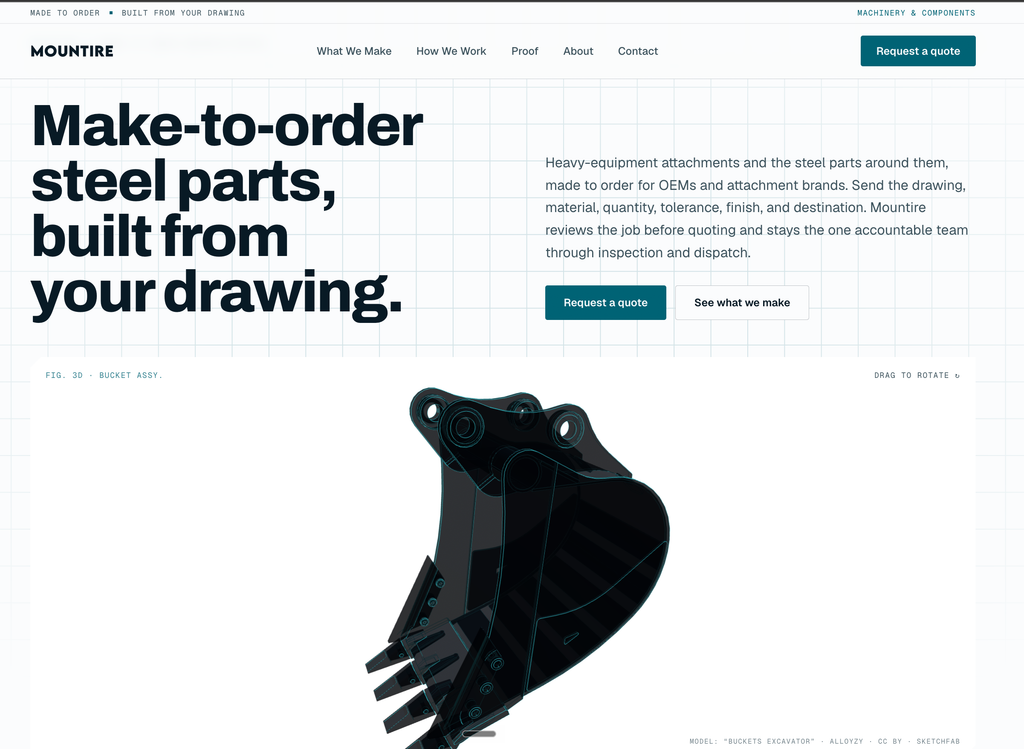
The Coimbatore company makes steel parts, buckets, weldments and full assemblies for original equipment manufacturers (OEMs) and attachment brands. It does this without owning every machine on the job. Mountire reviews the drawing, splits the work across a vetted network of cutting, forming, machining and welding shops, inspects what comes back, and ships it under one name. The OEM deals with one accountable team instead of five suppliers. It is the same execution-gap problem that platforms such as Jifwa attack on the paperwork side for Indian MSMEs.
What Mountire builds and how manufacturing as a service works
Mountire describes itself as the manufacturer behind brands rather than a brand of its own. Its catalogue covers buckets for excavators, wheel loaders, backhoes and skid steers, ground-engaging tools, quick hitches, abrasion-resistant wear packages, machined parts and complete fabricated assemblies.
The process the company lays out has five steps:
- The customer shares drawings and specifications in 2D, STEP, IGES or PDF.
- Mountire runs a manufacturability review before it quotes.
- Production moves across its managed network of partner shops.
- Every shipment is checked for dimensions, weld quality and finish.
- The order is dispatched with status updates along the way.
The company says it owns the recovery plan when a date slips. That promise is the core of the model. In a traditional sourcing setup, a late weldment from a sub-supplier becomes the OEM’s problem to chase. Under manufacturing as a service, the coordinator absorbs that risk and gets paid for absorbing it.
The partner network
Shops apply to join, and Mountire says it vets each one with a review, a visit or call, and a trial part before any purchase order goes out. Partners need proven capability, free capacity and documented quality control. There is no exclusivity clause, so a shop can keep its existing customers and fill idle hours with Mountire work.
Co-founder Nilofar Chhatriwala has described the model as one that uses partner manufacturers’ idle capacity. The asset-light structure means Mountire’s growth is limited by how many good shops it can qualify and manage, rather than by how much capital it can put into machinery.
Why the market is ready for manufacturing as a service
Manufacturing contributes roughly 16% of India’s GDP, according to IBEF, a share that has stayed in the 15 to 17% band for years. China averaged about 29% over 2011 to 2022. Closing even part of that gap requires capacity India already has but rarely organises well.
Policy is pushing in the same direction. The government’s Production Linked Incentive programme now spans 14 sectors with 806 approved applications and more than 12 lakh direct and indirect jobs, according to a PIB note from August 2025. The stated goal is to lift manufacturing to 25% of GDP.
Global buyers are also adding India as a second sourcing base after the supply shocks of the pandemic, a shift widely called China+1. Those buyers want Indian capacity, but they want it with documented quality and a single contract. A manufacturing as a service coordinator that speaks both the OEM’s language and the job shop’s language sits right in that gap.
Coimbatore is a natural base for this. The district administration calls it the pump city of Asia, supplying over 40% of India’s motor and pump requirements, backed by a dense cluster of small engineering firms. That cluster is Mountire’s partner pool. Launch91 has tracked a similar pattern in heavy industry, where companies like Navocem turn industrial byproducts into products buyers already trust.
Traction and proof points
Mountire Machinery and Components Pvt Ltd was incorporated in December 2020 and is registered in Coimbatore, according to MCA records. The company is bootstrapped and describes itself as growth stage, selling business to business.
Its manufacturing as a service offer currently centres on heavy earthmoving attachments and steel components, a segment where tolerances, weld integrity and wear resistance decide whether a part survives a mining shift. The company says it inspects dimensions, welds and finish on every shipment before dispatch.
Mountire grew out of a family metalwork business, and the company draws on that shop-floor experience in how it reviews drawings and qualifies partners. The next set of proof points readers should look for is the size of the qualified partner network, repeat orders from OEMs and the first export programmes.
The founder behind Mountire
Nilofar Juzer Chhatriwala came to manufacturing from software. She completed a B.Tech in Computer Science in 2012, worked as a software developer, and from 2015 ran systems at her parents’ company, according to a profile in Women Entrepreneurs Review.
She co-founded Mountire in 2020, in the middle of the pandemic and around the birth of her second child. Today she leads product development, operations, strategy and digital marketing. The profile quotes her advice to other women in industry: “embrace the journey and the challenges that come with balancing personal and professional life.”
The software background matters here. A coordination business lives or dies on information: which shop has free capacity, which part is late, which weld failed inspection. That is why the planned Mountire OS, a digital layer for scheduling and coordinating partner production, is a logical next step for a founder who started in code.
Why investors should watch Mountire
The timing. PLI incentives, the 25% manufacturing target and China+1 sourcing are all pulling OEM demand toward Indian suppliers at the same moment.
The wedge. Mountire starts in a narrow, demanding niche. Earthmoving buckets and wear parts are high-mix, steel-heavy and quality sensitive, which makes them hard for OEMs to source well from fragmented shops.
The model. Manufacturing as a service is capital light. Mountire earns on coordination, engineering review and quality assurance, while partners carry the machine assets. Margins in this model expand as software takes over scheduling and tracking.
The founder. A software-trained operator running a fabrication business is a rare combination in Indian engineering clusters.
The next milestone. Launching Mountire OS and publishing network metrics, such as qualified partners and on-time delivery rates, would turn a well-run service business into a scalable platform. As a bootstrapped company, Mountire enters any future funding conversation with control intact.
The bigger opportunity
India does not lack machines. It lacks a reliable way to make thousands of small shops act like one large supplier. If Mountire can prove manufacturing as a service in Coimbatore’s steel and fabrication cluster, the same playbook applies to every engineering hub in the country.
The OEMs that win the next decade of global sourcing will need partners who can promise one point of accountability across a fragmented base. Mountire is building exactly that promise, one qualified shop at a time.
FAQ
What is manufacturing as a service?
Manufacturing as a service is a model where one company takes an OEM’s drawings, distributes production across a network of vetted partner factories, checks quality and delivers finished parts under a single contract. The OEM gets capacity without managing many suppliers.
What does Mountire make?
Mountire makes excavator, loader, backhoe and skid-steer buckets, ground-engaging tools, quick hitches, wear packages, machined parts and complete steel assemblies for OEMs and attachment brands. Learn more at mountire.com.
Where is Mountire based and who leads it?
Mountire Machinery and Components is based in Coimbatore, Tamil Nadu. It was incorporated in 2020 and is led by co-founder and director Nilofar Juzer Chhatriwala.