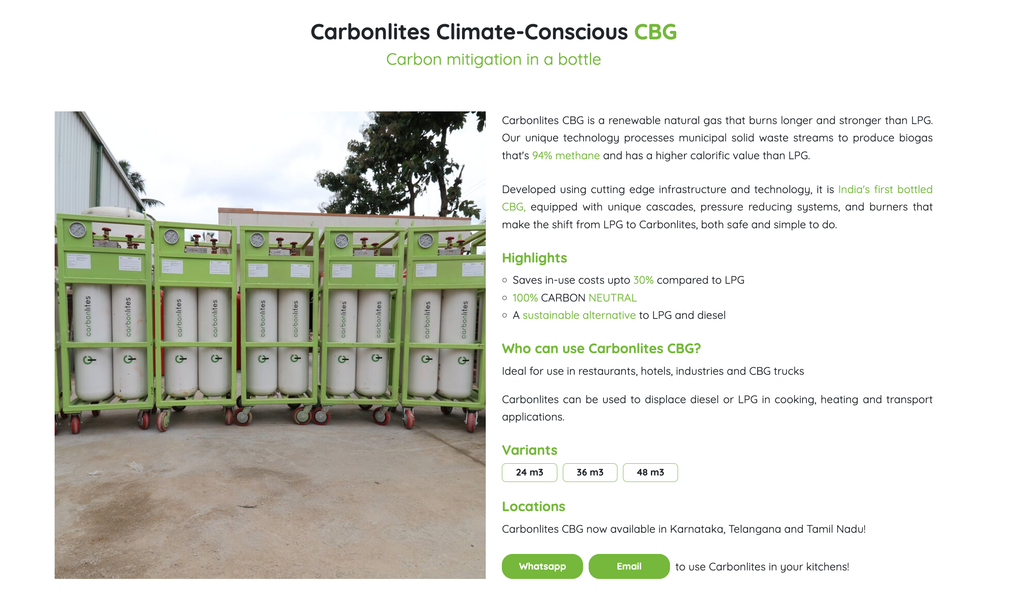
A busy hotel kitchen in Bengaluru can burn through several commercial LPG cylinders in a day, and send a bin of peels, leftovers and spoiled produce to the landfill every night. Carbon Masters wants to close that loop. The Bengaluru company turns the waste into food waste biogas, compresses it into bio-CNG under its Carbonlites brand, and sells it back to commercial kitchens as a cleaner cooking fuel.
The leftover digestate becomes a carbon-rich organic fertiliser for farmers. Carbon Masters describes the combination as a low carbon integrated utility, and the company says it is the first of its kind in India.
How Carbon Masters turns food waste biogas into a utility
The process starts with segregated wet waste from cities, markets and institutions. Inside an anaerobic digester, microbes break the organic matter down without oxygen and release a methane-rich gas. Carbon Masters cleans and upgrades that gas to compressed biogas, chemically similar to natural gas, and bottles or pipes it to customers.
What sets the model apart is how the gas is sold. Hotels, restaurants and caterers sign contracted, metered supply agreements that displace LPG for commercial cooking. The customer pays for the gas it uses, much like a utility bill, instead of managing cylinder deliveries.
The second product is fertiliser. The digested residue is processed into a soil conditioner rich in organic carbon, which the company sells to farmers to rebuild soil organic carbon. Carbon Masters says its fertiliser was selected for an organic farming programme run with the University of Agricultural Sciences at GKVK that reached 200 farmers.
Plants on the ground
The company’s project list includes:
- A 30 tonnes-per-day facility at Harohalli near Bengaluru, run through a joint venture with Hasiru Dala Innovations.
- A 25 tonnes-per-day plant with Siddipet Municipality, which the company calls Telangana’s first waste-to-CBG plant.
- An exclusive offtake arrangement for bottled CBG from a biogas plant in Namakkal, Tamil Nadu.
- “Carbonlites in a Box”, a neighbourhood unit in Koramangala built with the city corporation and a residents’ welfare association.
By September 2025 the company reported five CBG plants across Karnataka, Telangana and Tamil Nadu, processing more than 36,000 tonnes of municipal solid waste a year, along with clearance to inject gas into the GAIL pipeline network.
Why food waste biogas matters now
India generates about 1,62,000 tonnes of municipal solid waste every day, according to a PIB release from January 2026. A large share is wet, organic waste that releases methane when dumped in open landfills.
Policy has turned that problem into a fuel market. The SATAT scheme, launched in 2018, set out to build 5,000 compressed biogas plants and named municipal solid waste among its feedstocks. In 2023 the government made CBG blending mandatory, starting at 1% in FY2025-26 and rising to 5% from FY2028-29, according to PIB.
In August 2026, the Union Cabinet approved a unified GOBARdhan CBG scheme for FY2026-27 to FY2035-36 that targets nearly a tenfold rise in output and offers a stable gas price and capital support per tonne of capacity, according to PIB. More than 200 CBG plants have been commissioned so far. Demand is now guaranteed by regulation. For food waste biogas, the constraint is reliable feedstock and operators who know how to run plants on messy city waste.
That is where a decade of operating experience counts. Food waste biogas plants fail when segregation is poor, feedstock is inconsistent or offtake is uncertain. Carbon Masters has spent years solving all three on the ground. It is a pattern Launch91 has seen with other climate founders who build from overlooked inputs, such as Navozzo’s low-carbon concrete additives and Akvo’s atmospheric water generators.
Traction and proof
Carbon Masters was founded in the UK in 2009 and set up in India in 2012, according to the company. In 2017 it was already operating a plant near Malur and a unit at ISKCON Bengaluru, and Business Standard reported then that it sold the country’s first bottled bio-CNG.
The company’s food waste biogas business now earns from several lines: bio-CNG sales, fertiliser sales, plant operation and maintenance fees, and ancillary products. Customers include hotels, restaurants, caterers, industries, transport fleets and city gas networks. The team has grown past 80 people.
Recognition has followed. Carbon Masters lists the WWF India Climate Solver Award in 2017, a winning finalist spot in the Shell Foundation’s Make the Future accelerator the same year, and a place among Mission Innovation’s top 100 climate solutions.
The team behind Carbon Masters
Kevin Houston and Som Narayan co-founded the company. They started with a simple observation: Indian cities pay to haul away wet waste and then pay again to import LPG to cook food. A business that sits between those two flows can earn on both ends.
The founders chose a hard route. They built plants, signed municipal partnerships and learned to run digesters on unsegregated city waste years before national policy made CBG fashionable. That early start now shows up as operating know-how few new entrants have.
Readers can find more about the company at carbonlites.com.
Why investors should watch Carbon Masters
The timing. Mandatory CBG blending and the new GOBARdhan scheme give the sector a policy floor on demand and pricing for the next decade.
The wedge. Contracted, metered supply to commercial kitchens creates recurring revenue and a sticky customer relationship. Pipeline injection clearance adds a second route to market for surplus gas.
The business model. Three revenue lines from one feedstock: gas, fertiliser and plant operations. Municipal partnerships and joint ventures keep the capital load shared.
The backers. Indian Angel Network and Sangam Ventures invested in 2017. In September 2025 the company closed an equity round led by Schneider Electric Energy Access Asia, with Sangam and IAN participating, according to Indian Startup News.
The next milestone. The company is raising capital for five new plant SPVs. Commissioning those on schedule would show that the Carbonlites model can be replicated city by city.
The bigger opportunity
Every Indian city has the same two problems: too much wet waste and too much imported cooking fuel. Food waste biogas solves both with one plant, and Carbon Masters has spent more than a decade learning how to make that plant pay.
As blending mandates rise and cities push harder on segregation, the operators who already know the work will set the pace. Carbon Masters is positioned to become the food waste biogas utility that India’s kitchens and farms rely on.
FAQ
What is food waste biogas?
Food waste biogas is a methane-rich gas made when kitchen and market waste breaks down in a sealed digester without oxygen. Once cleaned and compressed, it becomes bio-CNG that can replace LPG or natural gas.
What does Carbon Masters sell?
Carbon Masters sells Carbonlites bio-CNG to hotels, restaurants, caterers, industries and fleets, and sells the leftover digestate as an organic fertiliser that improves soil carbon.
Where does Carbon Masters operate?
The company is headquartered in Bengaluru and runs or supplies from plants in Karnataka, Telangana and Tamil Nadu, including Harohalli, Siddipet and Namakkal.