In August, an insurer in Tamil Nadu wants to know which paddy fields went under water after a week of heavy rain. The satellite images it usually relies on show one thing. Cloud.
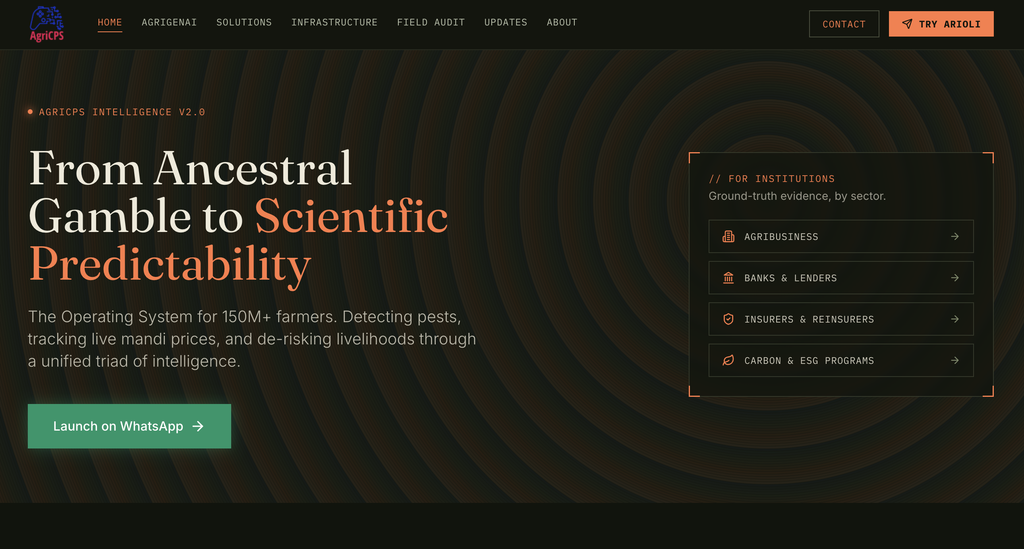
That gap is where Chennai-based AgriCPS has built its business. The bootstrapped startup runs satellite crop monitoring on free radar data, which sees through cloud, and turns each pass into a dated, section-by-section record of what changed on the ground. Every record states how confident it is and what it cannot see. A person reviews it before it goes out.
The deliverable is a one-page decision sheet, written so a third party can check it years later.
Why satellite crop monitoring fails when farmers need it most
Optical satellites go blind under cloud, and across much of India the cloudiest months are the kharif months, when flood and pest risk peak.
Synthetic aperture radar (SAR) works differently. It sends its own microwave signal and reads what bounces back, day or night, through cloud. In June 2026, Europe’s free Sentinel-1 radar constellation returned to its six-day repeat cycle, according to the Copernicus Data Space Ecosystem. AgriCPS says that puts a radar pass over every field every 6 to 12 days.
For satellite crop monitoring, data access was never the hard part. Trust is.
Under PMFBY, India’s crop insurance scheme, claims still lean largely on manual crop cutting experiments. Madhya Pradesh moved to the technology-based yield system YES-TECH from kharif 2023, giving it full weightage for soybean, wheat and paddy. Soybean growers in several districts then complained about delayed and lower payouts, and officials in Maharashtra flagged wide gaps between manual and technology-based yields, as Down To Earth reported in May 2026. Their ask was independent third-party analysis.
A number nobody can audit turns into an argument. AgriCPS builds its satellite crop monitoring for the person who has to defend the number.
Inside the AgriCPS decision sheet
The radar pipeline tracks four signals per field section: standing water, moisture pattern, canopy change and land use. Each change gets a date and a confidence level. The limits get printed on the page.
The sheet is written for whoever has to act on it. It names which sections to visit this week, why each one made the list, where it sits, and what the field team should record once there. That last instruction ties a satellite signal to a ground observation and leaves a record an auditor can follow. It is what separates this kind of satellite crop monitoring from a dashboard.
AgriCPS has published three live satellite crop monitoring demos on public parcels it doesn’t manage. One flags a 1.08-hectare weak zone inside a 7.6-hectare Dutch arable field. Another maps 20 canopy-change hotspots across a 105-hectare pine plantation against a 2019 to 2023 baseline. Each page says where radar does not beat optical imagery.
Few vendors volunteer that.
Who pays for it
The buyers are institutions carrying farm risk: crop insurers, banks lending against crops, agribusinesses sourcing from smallholders, and carbon programmes that need evidence a verifier will accept. For insurers, AgriCPS proposes a pilot that runs alongside an existing claims cycle and compares its findings with adjuster reports.
It’s a sensible way in. Nobody has to rip out a process to try it.
AriOli carries the same rules to the farmer
AriOli is a WhatsApp advisor that answers farmers in Tamil, Telugu, Hindi, Kannada or English. Farmers send a crop photo for a likely pest diagnosis or ask what their crop will fetch.
The discipline carries over. Prices come from the government’s Agmarknet feed across 10 states, with the market name and date on every quote. When no verified price exists, AriOli says so instead of guessing. A September 2026 update added a multilingual safety review on every agrochemical recommendation and began routing messages that signal distress to verified helplines. Farmers can also request one free radar-and-optical scan per field, which a person on the team reads before the report goes back on WhatsApp.
My read is that AriOli’s biggest strategic value sits on the B2B side. It gives AgriCPS a direct line to the same fields its institutional clients want to watch. For a company selling ground truth, that line is worth a lot.
A bootstrapped build with serious institutional backing
Founder and CEO Sheriff Babu brings more than 40 years of industrial experience to AgriCPS. The company has not raised an equity round. It has collected validation instead.
In July 2023, Tamil Nadu Agricultural University signed a three-year, ₹25.15 lakh MoU with AgriCPS to build AI-based early warning for pests and diseases in tapioca, per a TNAU press note. In February 2026, it was inducted as an incubatee of the iTNT Hub, IIT Madras and C-DOT (Samgnya) under the Quantum Incubation Program of the National Quantum Mission, with IIT Madras as research validator. The company is careful to say its quantum-assisted signal methods are still in development and kept apart from what ships today.
The rest of the support list is long for a company with no outside capital, including SSN iFound’s Elevate 2025 cohort, NVIDIA Inception and a $150,000 Microsoft Azure credit grant. Abroad, AgriCPS joined TBDC’s Pivot Program for Canada in June 2026 and was invited into FoodValley NL’s network in July.
What investors and founders should watch
The unit economics start in a good place. The raw data costs nothing, so the real costs are analysis and the human reviewer. If review time per field falls as volume grows, satellite crop monitoring at this level of rigour gets cheaper to deliver with scale.
That cuts both ways. Sentinel data is free to every competitor. The moat has to be method and track record, and track record only comes from pilots that publish results.
Human review is the product’s credibility and also its bottleneck. And at MVP stage, the company is stretching across India, Europe, Canada and a farmer app. Focus will decide a lot.
The marker I’d watch is a first paid pilot with an insurer or lender, plus a published comparison of AgriCPS findings against adjuster or field-officer reports. One honest number from that will sell harder than any feature.
The bigger bet
India’s real farm-data shortage is agreement. An insurer and a farmer rarely accept the same number about the same field.
AgriCPS is betting that satellite crop monitoring which states its confidence and leaves a trail a stranger can check will close that gap. If the decision sheet holds up in a live claims cycle, it stops being a report and starts being evidence.
Frequently asked questions
What is AgriCPS?
AgriCPS is a Chennai-based agritech startup that runs satellite crop monitoring on free radar data, producing dated, human-reviewed decision sheets for insurers, lenders and agribusinesses.
How does radar-based satellite crop monitoring work through clouds?
Synthetic aperture radar sends its own microwave signal and measures the return. Microwaves pass through cloud, so the readings keep coming in any weather, day or night.
What is AriOli?
AriOli is AgriCPS’s WhatsApp advisor for farmers. It quotes dated Agmarknet mandi prices and says plainly when it has no verified answer.
Related : https://launch91.com/policy/imf-global-outlook-spending-ai-risks-startups-2026/