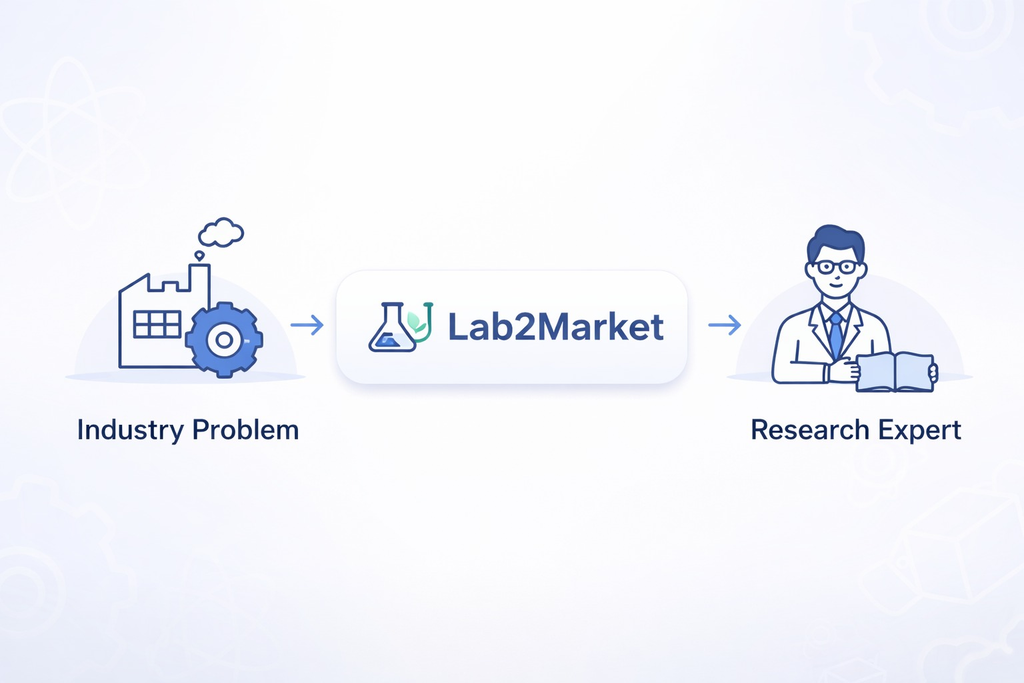
India has 5.70 crore MSMEs registered on the Udyam platform, and many of them cannot afford an in-house research team. Lab2Market, a startup building an industry-academia collaboration platform, is betting that the expertise these firms need already sits inside university laboratories across the country.
The Gap Between Factory Floors and Research Labs
Micro, small and medium enterprises contribute about 30% of India’s GDP and over 45% of its exports, according to the Press Information Bureau. They are also the businesses most likely to hit a technical wall with no one to call. A process that wastes material, a product that fails a durability test, a component that needs redesigning: each one calls for specialist knowledge that a small manufacturer rarely keeps on payroll.
The research side has the opposite problem. Professors and lab heads, particularly at institutions outside the top tier, often own the equipment and the domain depth to solve such problems. What they lack is a steady flow of funded industry work, and that is where industry-academia collaboration usually stalls.
The national numbers point the same way. The Economic Survey 2025-26 puts India’s gross R&D spending at 0.64% of GDP, against a range of 2.5% to 5% in innovation-led economies such as the US, China and Israel, as reported by Forbes India. The Survey traces the shortfall to thin private-sector participation and a weak record of turning research into commercial products, and describes the stretch between early research and market-ready products as a “valley of death.”
How Lab2Market’s Industry-Academia Collaboration Platform Works
Lab2Market positions itself as a verified matchmaking layer between the two sides. A company posts a technical challenge along with a budget and a timeline. Researchers build profiles that list their specialisations, lab facilities, patents and earlier projects. The platform then connects the two.
The design goes past a directory. The proposed workflow covers verification of both researchers and companies, project proposals, direct messaging, NDA and confidentiality handling, milestone tracking and payment options. Each piece removes a reason why an MSME owner or a professor might walk away from a first conversation.
What MSMEs Get
An MSME gains access to applied research, product development help and process improvement support without setting up a lab or hiring a full-time specialist. Budgets and timelines are defined upfront, which gives a small business owner a way to scope an engagement before committing money.
What Researchers and Institutions Get
Researchers get a route to industry-funded projects and consulting work without having to launch a company of their own. Institutions get something they increasingly need to show: measurable industry-academia collaboration and research outcomes with a paper trail.
Where the Platform Meets Public Policy
The timing matters. The Prime Minister operationalised a Rs 1 lakh crore Research, Development and Innovation Scheme in November 2025 to draw private money into research, and the Economic Survey recommends Translational Research Centres to support prototyping and piloting for startups, MSMEs and academic institutions.
Lab2Market’s plan to support government and CSR-funded innovation programmes fits that direction. A platform for industry-academia collaboration that already holds verified profiles, scoped projects and milestone records could give a funder what it usually lacks: a clean view of who is working on what, and whether the work is on track.
The Roadmap: Pilots First, AI Later
The company’s proposed rollout is sequenced sensibly. It starts with pilot collaborations between colleges and MSMEs, moves to regional expansion, then to partnerships with industry associations and government programmes. AI-based researcher matchmaking and collaboration analytics come last.
That order is worth noting. Algorithms need data, and data comes from completed projects. By building the trust infrastructure for industry-academia collaboration first, Lab2Market earns the right to automate matching later. The focus on regional industrial clusters and researchers from tier-2 and tier-3 institutions also carves out ground that national, top-institution-led programmes tend to leave thin.
What Investors and Founders Should Watch
Every two-sided platform, this industry-academia collaboration platform included, lives or dies on density. A professor who sees no relevant MSME projects will stop logging in, and so will a manufacturer who finds no qualified researcher nearby. Regional clusters are the natural place to solve this, because a few dozen active participants in one city or industry belt can make the marketplace feel alive.
Intellectual property terms will be the second test. Who owns the outcome of a funded project, how confidentiality holds when a professor’s students are involved, and how disputes get settled are the questions that decide whether a first project becomes a tenth. Lab2Market’s emphasis on NDA management and milestone tracking suggests the team knows where the friction sits.
Payments are the third. Milestone-linked payouts give both sides a reason to stay on the platform after the introduction, which is where most marketplaces leak.
The Bottom Line
India already has the researchers, the labs and the businesses with unsolved problems. What has been missing is a dependable way to put them in the same room with a contract, a timeline and a shared definition of done. Lab2Market is building that room for the industry-academia collaboration that India’s R&D numbers say it needs. If it gets the trust layer right, the research that stays trapped in laboratories today becomes the growth engine for the country’s smallest factories tomorrow.
Related : https://launch91.com/uncategorized/godraw-solo-founder-rishabh-gupta/