
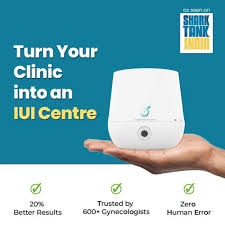
SUBHAG HealthTech sells a centrifuge, but the product it really sells is confidence. Indian gynecologists routinely perform intrauterine insemination (IUI), yet many lack the lab setup or the embryologist needed to prepare the sperm sample properly. The company built AndroWash to close that gap. Its co-founder Chandan Prasad, has spent years making sure clinics find the device, understand it and buy it.
A gap inside a growing market
India’s fertility market is expanding quickly, though the forecasts disagree on the pace. Ichelon Consulting puts the IVF market above ₹6,200 crore in 2026 and ₹19,500 crore by 2030, about 22% a year. Custom Market Insights projects $1.41 billion in 2025 growing 16.23% annually through 2034. Markets and Data sits lower, at 13.51%. Every source has the market growing fast.
Ichelon also expects more than 1,000 new IVF centres over five years. Most new centres and small IUI clinics start with the simplest procedures. That is where SUBHAG HealthTech sits, selling equipment for the step that comes before IVF.
The Assisted Reproductive Technology (Regulation) Act, 2021 adds pressure. Clinics now need registration and formal standards, and SUBHAG lists ART registration support alongside its hardware.
The product bet: remove the embryologist
The company describes AndroWash as the world’s first automated sperm washing protocol for IUI and IVF clinics. That is its own claim, and we could not verify it independently. The specifications are concrete, though. The device runs a locked cycle of 2,200 RPM, roughly 350g, following the WHO laboratory manual. A patented Smart Tube keeps the sperm pellet separate from the supernatant after the spin. A trained staff member can process a sample in 15 to 20 minutes.
The company cites Indian Patent No. 404167 and ISO 13485 certification. Trade listings put the machine near ₹1.1 lakh.
Co-founder Sohan Kumar told Indian Startup Times that gynecologists can perform IUI but often lack the knowledge or equipment for sperm washing. A locked protocol turns a skilled lab task into a repeatable routine. For a clinic owner without an embryology team, that is the entire pitch.
The limits are real. The device is built for one sample at a time, so a high-volume centre will want to do the math before buying. It also follows the WHO laboratory manual for human semen examination, which means its results depend on clinic discipline around sample handling.
Education is the distribution channel
Selling medical equipment to small clinics is slow because the buyer is also the person taking the risk. SUBHAG HealthTech’s answer is to put education where other companies put ads.
Its site carries a knowledge hub, scheduled CME workshops, recorded sessions and free registration for them. There is an ROI calculator, which speaks to the question every clinic owner asks first: how many cycles until this pays for itself? A distributor page recruits regional partners. Buyers pay a ₹5,000 booking amount adjusted against the final invoice, and the package includes installation and SOP training.
I think this is the right order of operations. Awareness is cheap to buy and trust is not. A doctor who has watched a recorded session, run the ROI numbers and spoken to a trainer arrives at the sales call already half convinced.
The adoption engine behind the brand
Chandan Prasad brings more than 11 years across digital marketing, content, SEO and B2B lead generation. His public positioning goes beyond brand work. On Topmate, he offers guidance to hospital and clinic owners and gynecologists on launching IUI clinics built around AndroWash.
The session topics show how he thinks about the customer. One is aimed at pathology labs with spare space that could become IUI centres. That is a buyer segment most fertility companies ignore, and it widens the market without a new product.
The company is also building a field team. A recent Head of Sales listing for AndroWash asks for someone to lead executives across Kolkata and nearby regions and close institutional deals with hospitals, fertility clinics and diagnostic labs. Content creates the inbound interest, and field sales converts it into orders.
Proof points and open questions
SUBHAG HealthTech has a few credible signals behind it. The company says it was founded in 2018 in Bengaluru as an India-Germany collaboration, appeared on Shark Tank India Season 2 and is supported by Social Alpha, a Tata Trusts initiative. We could not find the terms of its Shark Tank deal, so we have not reported any figures.
For founders and investors, three things are worth watching.
The first is consumables. The machine is a one-time sale, but culture media, Smart Tubes and wash kits repeat with every cycle. If attach rates are high, revenue per clinic grows long after installation.
The second is evidence. Most outcome claims on the company’s blog are self-published. Independent clinical data would do more for doctor trust than another webinar.
The third is distributors. The model needs regional partners who can train clinics locally, and how fast that network grows will show whether the education-led approach scales past the founding team.
SUBHAG HealthTech is betting that the next wave of Indian fertility care will be built by smaller clinics with modest labs, and that the company able to teach them will own the category. The bet is reasonable. It depends on execution in the field, which is where marketing stops and operations begin.