Every year, millions of Indians pay a stranger to tell them what’s coming next. The astrology-tech industry has built an entire economy on that single question. The Hidden Pattern startup is betting on a different one: not what will happen to you, but what keeps happening through you.
Founded by Aadi Vihaang, Hidden Pattern is a self-discovery platform built around helping people recognise patterns they keep creating, tolerating, or reacting to. Users submit their full name and date of birth. In return, they get a personalised PDF, the Hidden Pattern Map, delivered to their inbox within roughly 30 minutes, priced at an introductory ₹699. That intake mechanism sits close to a numerology reading. The framing does not.
The Problem With Prediction-First Self-Help
Vihaang’s starting observation is simple: most self-discovery tools sit at one of two extremes. Either they lean mystical, selling certainty about a future nobody can see, or they go generic, the kind of advice that applies to everyone and therefore helps no one in particular.
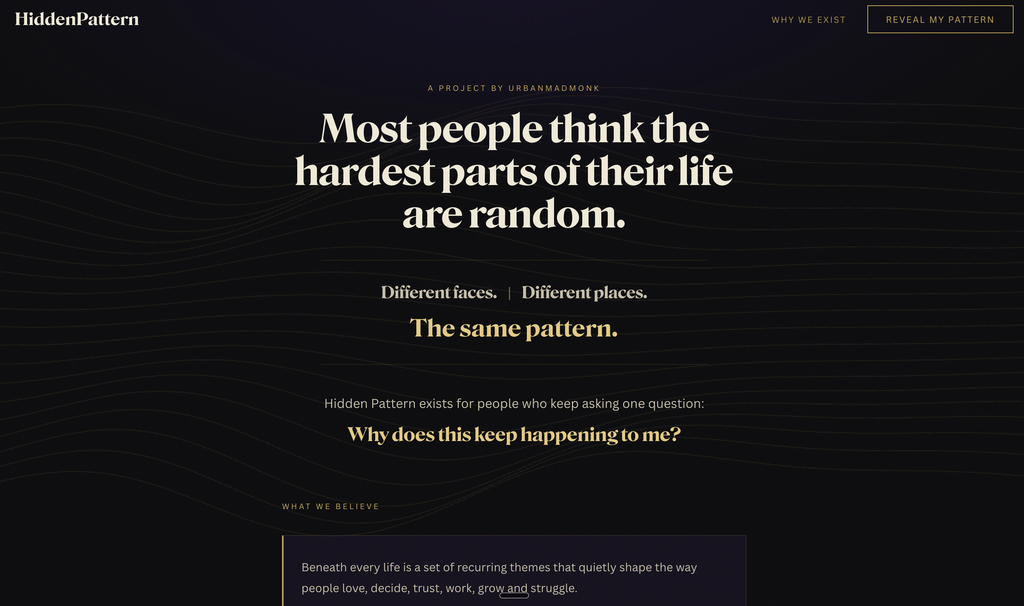
Hidden Pattern is trying to occupy the middle. “Once you can name a pattern, it starts to lose its grip,” the company says on its site, building its entire pitch around recognition instead of forecasting.
That distinction matters more than it sounds. A horoscope tells you what Saturn has planned next. Hidden Pattern reads the present instead. It tells you what you’ve been quietly repeating, in relationships, at work, in the choices you keep making and calling coincidence.
Inside the Hidden Pattern Startup: How the Product Works
The Hidden Pattern startup runs on what the founder describes as a homegrown AI stack, built around the product’s own methodology rather than a general-purpose chatbot wrapper. Three layers feed into it: structured personal inputs from the user, a proprietary pattern framework built in-house, and an AI interpretation layer that turns both into the final report.
The output isn’t a chart of planetary positions. It’s a written breakdown of tendencies, in career, relationships, and decision-making, meant to read like something a sharp friend would tell you after watching your life for a decade.
Early users of the Hidden Pattern startup describe the maps as going deeper than typical self-reflection content, with one Delhi-based reader calling it worth the price, and a Hyderabad-based reader saying her sister found the relationship section unsettlingly accurate. Two data points aren’t a trend. They do suggest the product is landing with the audience it’s built for.
Pattern Literacy, Not Fortune-Telling
Ask Vihaang why the Hidden Pattern startup exists and the answer isn’t about market size. It’s about a phrase he calls Pattern Literacy: the ability to notice what you repeatedly create, tolerate, or respond to, and to use that noticing to make a different choice next time.
This is the philosophical spine of Hidden Pattern, and also its biggest point of differentiation. This isn’t fortune-telling. The product isn’t selling certainty about tomorrow. It’s selling a clearer read on today, built from data the user already carries about themselves.
Why Now: A Crowded, Well-Funded Category
Hidden Pattern isn’t launching into empty space. India’s digital astrology and spiritual-tech sector has pulled in more than $50 million in venture funding, and Astrotalk alone has raised close to $30 million while crossing ₹100 crore in net profit in FY24, according to data compiled by Upstox. InstaAstro, a direct rival to Astrotalk, has raised $17.5 million across six rounds and was reportedly in talks with Flipkart over a stake. The appetite for structured self-understanding is real and well-capitalised, even if most of that money has gone toward prediction, not reflection.
Zoom out further and the pattern holds. The global personal development market was valued at roughly $57 billion in 2026 and is projected to cross $72 billion by 2030, per Research and Markets. Within that market, the self-awareness segment specifically is growing faster than almost any other category. Hidden Pattern sits precisely at the overlap: too structured for the wellness crowd, too personal for enterprise coaching, and deliberately distant from astrology’s language even while borrowing its delivery mechanics.
The Real Challenge: Old Framework, New Credibility
Vihaang is candid about the hardest part of building the Hidden Pattern startup. Pattern recognition as a concept is old. Every therapist, coach, and grandmother has some version of “you always do this.” The challenge isn’t inventing something new. It’s making something old feel modern, useful, and credible, without sliding into the exaggerated claims that plague the wellness industry.
That’s harder than it sounds. Numerology-adjacent products live and die on trust. One overpromised claim, one report that feels generic instead of personal, and the whole premise collapses. Hidden Pattern’s bet is that AI-driven personalisation, done carefully, can hold that trust at a scale no individual coach or astrologer could match.
What Comes Next
The Hidden Pattern startup is bootstrapped, currently running a freemium model and using early usage data to shape the product rather than a funding round or a growth playbook. That’s a deliberate choice at this stage, and a real constraint too. No outside capital means no outside pressure, but it also means slower iteration than a funded rival could afford.
The ambition goes well beyond one report. Vihaang wants Hidden Pattern to grow from a single personalised map into a fuller self-discovery platform covering career decisions, relationships, and the choices people make on repeat without noticing. The company’s own framing is the clearest summary of the bet: it isn’t trying to predict anyone’s life. It’s trying to help them see the parts of it that were already visible, if only they’d known where to look. Seeing it is the whole point.
Trending : https://launch91.com/uncategorized/ai-fashion-photography-platform-sareeviz/