In May 2020, with factories shut and supply chains frozen, the Ministry of Railways placed an urgent order for a 3D printer at North Western Railway’s Jodhpur workshop. The machine came from a small, bootstrapped team in Surat. Four months later a second one went to the Northeast Frontier Railway’s coaching depot in Guwahati, where engineers used it to develop spare parts for regional coaches, as Manufactur3D reported.
That company is Make3D, and its pitch is simple. An Indian plant, lab or defence unit should be able to buy an industrial 3D printer designed and built in India, get it serviced locally and print the part it cannot import in time.
Twelve years after its first prototype, Make3D sells a family of machines that runs from desktop units to a printer with a one-metre build platform. It has stayed bootstrapped throughout.
How Make3D builds its industrial 3D printer range
Make3D works across the three technologies most Indian buyers ask for. Each one solves a different shop-floor problem.
Pratham series: FDM for parts and prototypes
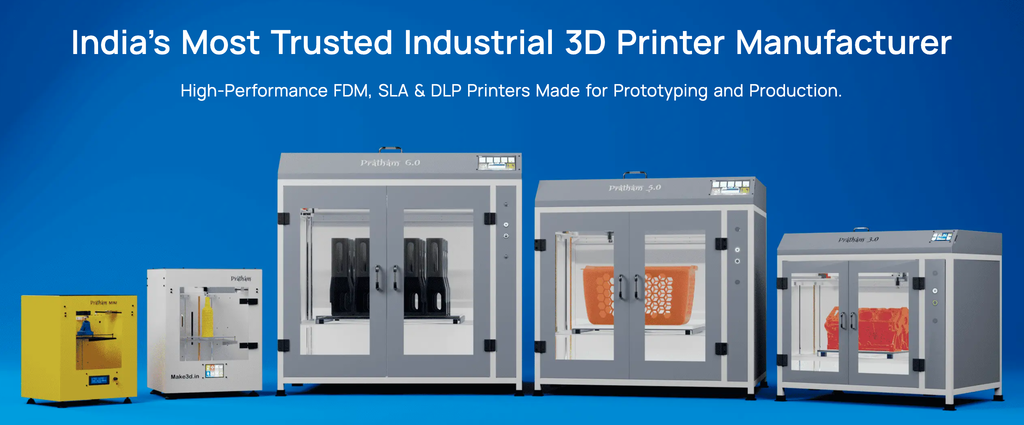
The Pratham line uses fused deposition modelling (FDM), which melts a plastic filament and lays it down layer by layer. The range climbs from the Pratham Mini and Desktop (a 200 x 200 x 250 mm build volume) to the 3.0, 5.0 and 6.0, named roughly for their build size in centimetres.
At the top sits the Pratham X, the largest industrial 3D printer in the range. When it launched in September 2023, 3DPrint.com reported a 1000 x 1000 x 600 mm build volume, a heated bed, nozzles rated to 280°C and test prints running up to 245 hours. That size lets a factory print a full jig, fixture or housing in one piece.
The newest model, the Pratham 3 Rapid, is rated by the company at 500 mm/s print speed.
EKA and iSLA series: resin for fine detail
For jewellery, dental and engineering parts that need smooth surfaces, Make3D builds resin printers. The EKA series uses DLP and LCD light engines to cure liquid resin, and the iSLA series uses laser-based stereolithography for larger parts.
Resin systems matter in Surat, home to one of the world’s largest diamond and jewellery clusters. Make3D’s first DLP machine, the EKA Star, was aimed squarely at that trade when it was unveiled in 2019.
Scanning and reverse engineering
The third leg is services. Make3D offers printing, 3D scanning and reverse engineering, which turns a physical part into a digital model that can be reprinted or machined.
The founders say this is where their defence work sits. They help defence teams build prototypes and reproduce hard-to-source components, especially legacy parts whose original suppliers no longer exist.
Why India needs a homegrown industrial 3D printer maker now
Additive manufacturing has moved from a design studio novelty to a supply chain tool. India’s policy has followed.
The Ministry of Electronics and IT’s National Strategy for Additive Manufacturing set a goal for India to capture 5% of the global additive manufacturing market and add close to $1 billion to GDP. It also called for 50 India-specific technologies and 100 new startups in the field.
Most industrial machines in Indian plants, including almost every industrial 3D printer, are still imported. That creates long lead times for spares, foreign currency costs and dependence on overseas service teams.
A domestic industrial 3D printer changes that equation for three groups. Railway workshops and public sector units gain a faster route to spare parts. Engineering colleges and AICTE-backed innovation labs get affordable machines for students. Small manufacturers in tier 2 and tier 3 cities get local demos and local repair.
Traction and proof
Make3D’s strongest evidence is its public sector record. The two railway installations in 2020 were reported in the trade press, and then Railway Minister Piyush Goyal publicly backed the idea of printing components in-house.
The company says it has served more than 2,500 clients, including IITs, ISRO and defence establishments, and has printed over 27,000 parts through its service arm. It reports ISO 9001:2015 certification and CE marking. Trade coverage from 2019 listed ISRO and engineering colleges among early users of its resin printers.
Each industrial 3D printer is sold through a national partner network. Make3D lists authorised partners in more than ten cities, from Delhi, Mumbai and Bengaluru to Guwahati, Ludhiana and Jabalpur.
The founders behind Make3D
Jatin Goti and Tejas Diyora both studied at Gujarat Technological University. They then worked at an R&D facility building products for Surat’s diamond industry, according to The Machine Maker.
They began prototyping printers in 2014 and registered the company in 2016. Their first machine was a 200 x 200 mm build, made after they struggled to find any engineering unit willing to fabricate a small prototype batch.
That early friction shaped the business. A founder team that once could not get a part made now sells machines whose whole purpose is to make parts on demand.
Why investors should watch Make3D
Timing. National policy on additive manufacturing, defence indigenisation and import substitution all point the same way. Buyers in railways, defence and education increasingly prefer Indian-made equipment with local service.
The wedge. Make3D owns the full stack from hardware design to service bureau. A customer can start by buying printed parts, move to a desktop machine and later upgrade to a large-format industrial 3D printer from the same vendor.
Business model. Revenue comes from machine sales, consumables, printing and scanning services, and reverse engineering projects. Hardware creates the relationship, while resin, filament and service work add repeat income from each installed machine.
Capital efficiency. The company has grown without outside funding, according to its submission to Launch91. For an investor, that means an operating hardware business with a national partner network already in place.
Next milestone. The proof point to watch is a repeatable defence contract for reverse-engineered or printed components. That would move Make3D from equipment supplier to qualified production partner, a status that carries longer contracts and higher margins.
What comes next
Indian manufacturing is shifting from “import the part” to “print the part”. The companies that win that shift will be the ones with machines already on factory floors and engineers who can turn a broken legacy component into a print file.
Make3D has spent twelve years building both. Its founders set out to prove that India could design its own industrial 3D printer, and the next chapter is about proving it can supply the parts that keep the country’s trains, labs and defence systems running.
For more Indian hardware stories, read how Mountire is building manufacturing-as-a-service for OEMs and how Indrones turns drone data into geospatial intelligence.
FAQ
What does Make3D make?
Make3D designs and manufactures industrial 3D printers in Surat, Gujarat. Its range covers the Pratham FDM series, the EKA and iSLA resin series, plus printing, 3D scanning and reverse engineering services.
What is the largest industrial 3D printer Make3D sells?
The Pratham X has a build volume of 1000 x 1000 x 600 mm, large enough to print jigs, fixtures and housings in a single piece.
Who uses Make3D printers?
Indian Railways workshops, engineering colleges, manufacturers and jewellery makers use its machines. The company says it also supports defence teams with prototypes and replacement components.