India wants to store far more electricity than it does today, and most of that storage still runs on lithium it has to import. Every new grid battery, telecom tower and electric two-wheeler adds to that exposure.
Aatral ESP, a women-led startup from Tamil Nadu, is betting that the answer sits in common salt. The company is building a sodium-ion battery platform around NASICON cathode materials, aimed at grid storage, mobility and critical infrastructure, with government and institutional buyers as its first market.
What Aatral ESP builds and how its sodium-ion battery works
A lithium-ion cell moves lithium ions between two electrodes as it charges and discharges. A sodium-ion battery does the same job with sodium ions, and sodium can be drawn from an element found in seawater and table salt rather than a handful of mining regions.
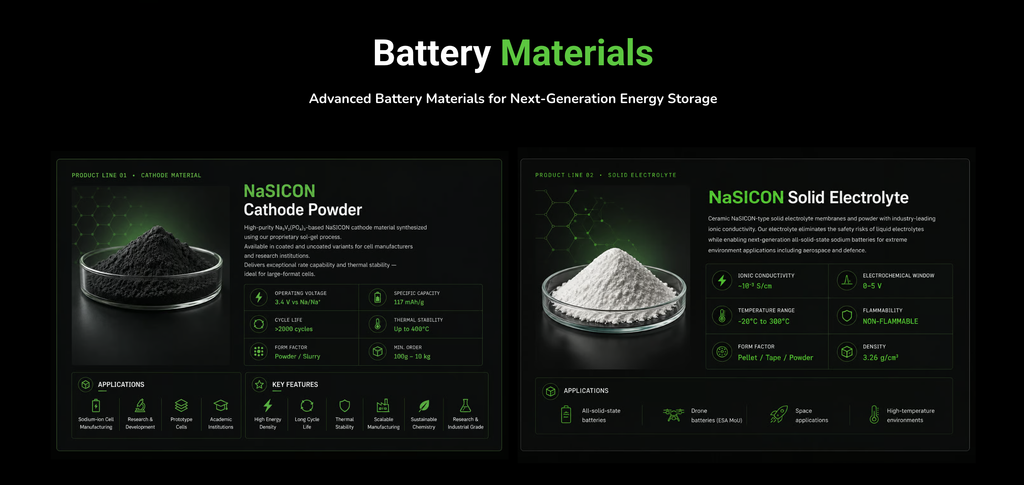
Aatral’s chosen cathode family is NASICON, short for Sodium Super Ionic CONductor. These materials have an open, three-dimensional crystal framework that lets sodium ions move quickly and holds its shape well under heat, which is why researchers have studied them for safer cells. The company says it pairs NASICON cathodes with hybrid and solid electrolytes, and that it is among the first companies globally to commercialise this combination for battery systems.
From materials to cells
The Aatral ESP product range runs across the whole stack:
- Battery materials, including its cathode chemistry
- Cells in 18650 and 32700 cylindrical formats and pouch formats
- Packs for electric mobility and stationary energy storage
- Paid R&D services covering electrode making, coin and pouch cell builds and electrochemical testing, delivered under NDA
That last line matters for a young deep tech company. Testing services earn revenue from the same lab equipment the core product depends on, and they put the team in front of other battery developers every week.
Why the sodium-ion battery market is opening now
India’s storage push is being written into policy. The government’s Advanced Chemistry Cell PLI programme targets 50 GWh of domestic cell manufacturing with an incentive pool of Rs 18,100 crore, plus a separate 5 GWh window for niche cell technologies. In 2026 the Ministry of Heavy Industries opened a further 10 GWh tranche focused on grid-scale stationary storage.
Raw materials are the other side of the story. In January 2025 the Union Cabinet approved a National Critical Mineral Mission with a total outlay of Rs 34,300 crore, aimed at reducing India’s import dependence for lithium, cobalt and other battery minerals.
A sodium-ion battery sidesteps much of that dependence by design. Sodium chemistries also tend to tolerate heat and deep discharge well, which suits Indian summers, telecom backup and grid sites where weight matters less than safety and cost per cycle.
Where sodium fits first
Sodium-ion cells carry less energy per kilogram than the best lithium cells, so the early wins are in stationary storage, two- and three-wheelers and backup power. Those are exactly the segments Aatral lists on its website, alongside a newer focus on stabilising grids that serve data centres, utilities and critical infrastructure.
Aatral is part of a wider wave of Indian energy hardware startups. Launch91 has profiled Inventus and its solid-state Ceramion cells and TriNano’s coating that lifts solar panel output, both aimed at the same clean power build-out.
Traction and proof points
Aatral has assembled an unusual mix of institutional backing for a company at its stage. On its website the company lists:
- A Mercedes-Benz research grant in 2025, awarded through the Vilgro Foundation
- A Phase 2 award under Fraunhofer’s AHEAD programme
- Recognition under the IFC She Wins Climate initiative
- Recognition under the MSME Innovation Scheme’s business incubator track
- The Homepreneur Award in 2022
It has also signed an MoU with Garuda Aerospace to research indigenous sodium batteries for drones, and says it is collaborating with the European Space Agency on sodium-ion batteries for space applications. Its academic and ecosystem partners include Anna University, and its advisors include the managing director of TUM Venture Lab ChemSPACE in Munich and a renewable energy professor at the University of Dayton.
The company describes itself as at the early revenue and traction stage, with paid testing services and pilot cells as its first commercial lines.
The founder and team behind Aatral ESP
Aatral is led by CEO Subathra Rajendran, who has built the company as a women-led technology startup and has been recognised in Tamil media for that work. The company also runs internship programmes, including placements for interns from Ethiopia.
Her core team splits cleanly across the problem. Dr. Soundharrajan leads R&D, Ashokkumar serves as CTO, Dr. Divakar Bala leads AI work, and Vivek Mani handles strategy.
That combination of cell chemistry, engineering and software reflects how battery value is shifting. Buyers increasingly want cells that come with data on how they will age, and an AI lead on a materials team signals that Aatral plans to sell performance data alongside its chemistry.
Why investors should watch this sodium-ion battery startup
The timing trigger. India has a 50 GWh cell manufacturing target, a fresh grid storage tranche and a mission to cut critical mineral imports. A lithium-free sodium-ion battery chemistry lines up with all three.
The wedge. NASICON cathodes are less crowded than the layered-oxide and Prussian-blue routes most sodium players have taken. If Aatral’s materials deliver on safety and cycle life, it holds a defensible position at the materials layer, where margins tend to be stickier than in pack assembly.
The business model. The founder describes Aatral as B2G, selling first to government and public-sector buyers such as utilities, public institutions and space programmes. R&D and testing services run alongside, which brings in revenue while cell production scales.
The capital picture. Aatral reports raising between USD 100,000 and USD 500,000 to date, and announced an angel-backed corpus fund deal on its website. For a battery materials company carrying this many institutional validations, that is a lean base.
The next proof points. Three milestones would de-risk the company quickly:
- Published third-party cycle-life and temperature test data for its cells
- A first paid pilot with a utility, telecom operator or public-sector buyer
- A seed round sized to move from pilot lines to a dedicated cell line
The bigger opportunity
Battery supply chains are being redrawn country by country, and India has said clearly that it wants its own. Chemistries built on abundant materials will matter as much as gigafactories in that plan.
Aatral ESP has spent its early years collecting validation from Mercedes-Benz, Fraunhofer and the IFC while building a sodium-ion battery stack from cathode to cell. If its first government pilots convert, a Tamil Nadu lab could become one of the reasons India’s stored energy runs on salt.
Frequently asked questions
What is a sodium-ion battery?
A sodium-ion battery stores and releases energy by moving sodium ions between electrodes, the way a lithium-ion cell moves lithium. Sodium is abundant and widely available, which lowers supply risk and cost exposure.
What does Aatral ESP make?
Aatral ESP develops NASICON-based cathode materials, sodium-ion cells in cylindrical and pouch formats, packs for storage and mobility, and offers battery testing and R&D services.
Who leads Aatral ESP?
Aatral ESP is led by CEO Subathra Rajendran, with a team covering R&D, engineering, AI and strategy, and advisors from TUM Venture Lab ChemSPACE in Germany and the University of Dayton in the US.