
Ask anyone who has lived with psoriasis for a decade and the story is often the same. A steroid cream calms the flare, the skin thins, the cream stops and the plaques come back. The World Health Organization describes psoriasis as a chronic, painful and disabling disease with no cure, which means most patients manage it for life.
That long tail of treatment is the gap a psoriasis nanogel from IIT Bombay is built to fill. NanoTherapX Innovations, a Mumbai deep tech startup incubated at SINE IIT Bombay, is developing PsorisCare, a steroid-free gel that uses plant-derived nanoparticles to carry an anti-inflammatory compound deep into psoriatic skin.
The company was incorporated in April 2025. Its science goes back more than five years, to a doctoral project in IIT Bombay’s Department of Biosciences and Bioengineering.
How the PsorisCare psoriasis nanogel works
PsorisCare, which the team also calls Phytonanogel Shield, has two layers of engineering.
The active ingredient is eugenol, a compound found in clove oil with known anti-inflammatory and antioxidant properties. The team packs it inside lipid nanoparticles in the 180 to 220 nanometre range, with an encapsulation rate of around 85%.
Those particles are then suspended in a film-forming hydrogel. Once applied, the gel holds the particles at the skin surface and releases them slowly, which the company says lasts more than 48 hours. For a patient, that could mean one application a day instead of two or three.
Why particle size matters
Psoriatic plaques are thick and scaly, so most topical drugs struggle to get past the surface. A psoriasis nanogel gets around this because particles under about 200 nanometres slip through that barrier more easily.
In a preprint published on bioRxiv, the researchers report roughly three times higher eugenol concentration in the epidermis and dermis compared with a conventional eugenol gel. The formulation also targets reactive oxygen species and IL-17 driven inflammation, two pathways linked to how psoriasis flares.
Making the psoriasis nanogel is a solvent-free process that uses excipients already on the generally recognised as safe list. That choice keeps manufacturing close to standard pharma equipment and simplifies the regulatory file.
The market for a steroid-free psoriasis nanogel
The company estimates about 10 million psoriasis patients in India and 125 million worldwide. It also estimates that around 70% of patients have mild to moderate disease, the group most dependent on topical creams.
Today those patients choose between three imperfect tiers. Corticosteroid creams work fast but cannot be used for long. Phototherapy and systemic drugs bring irritation and toxicity concerns. Biologics work well but, per the company’s analysis, cost upwards of ₹50,000 a month and require injections and lab monitoring.
NanoTherapX is aiming its psoriasis nanogel at the space in between. The company’s target retail price for a 30 g tube is about ₹150, which would sit well below the steroid and vitamin D creams it benchmarks against.
The timing also helps. India’s regulator, the Central Drugs Standard Control Organisation, offers a defined route for new drug and phytopharmaceutical approvals, and a topical product with known excipients faces a lighter safety burden than an injectable.
Traction and scientific proof
At this stage, the proof that matters for a psoriasis nanogel is scientific, and NanoTherapX has built a solid file.
- Patent: The company says the nanogel is protected under Indian Patent No. 53382, with further filings planned for composition, process and method of use.
- Peer review: The team says its findings appear in ACS Pharmacology & Translational Science, building on the bioRxiv preprint.
- Preclinical results: In an imiquimod-induced mouse model, the company reports PASI-like scores falling from 3.75 to 0.5 within five days, with no liver or spleen toxicity observed.
- Customer discovery: The team has interviewed more than 50 psoriasis patients across government and private hospitals in Mumbai and Delhi, alongside practising dermatologists.
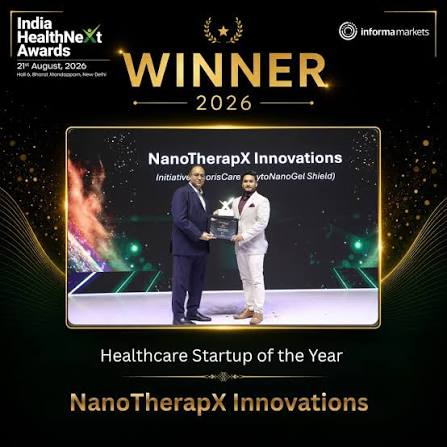
The recognition has followed. IIT Bombay lists the project among its Gandhian Young Technological Innovation (GYTI) Appreciation Award winners. The company also cites a Prix Galien nomination in 2025 and a place in the CAS Future Leaders Top 100.
The scientists behind NanoTherapX
Dr Roshan Keshari built PsorisCare through his PhD and postdoctoral work at IIT Bombay. His research was supported by a DAAD doctoral scholarship from Germany, and he spent time as a visiting scholar at the Max Planck Institute.
He co-founded NanoTherapX with his doctoral supervisors, Prof Rohit Srivastava and Prof Shamik Sen of IIT Bombay’s Department of Biosciences and Bioengineering. Both have long track records in biomaterials and translational medicine.
The team is advised by senior dermatologists on safety and usability, and by chartered accountant Dr Ashok Ajmera on finance and corporate strategy. That mix of lab depth and clinical input is what turned a thesis into a company.
Why investors should watch NanoTherapX
The trigger. Patients and dermatologists are actively looking for steroid-sparing options, and India has no domestic non-steroidal nanogel for psoriasis on the shelf. A topical route with safe excipients shortens the regulatory path compared with new systemic drugs.
The wedge. The psoriasis nanogel pairs an inexpensive plant active with a delivery system that the company says lifts skin uptake threefold. A granted patent and a published study give it defensible IP from day one.
The business model. NanoTherapX plans to sell its psoriasis nanogel through dermatologist prescriptions, pharmacies and e-pharmacy platforms, using contract manufacturers to stay asset-light. Licensing and co-marketing with larger pharma companies is a second revenue line. The company projects manufacturing at roughly ₹8 to ₹10 per application, which leaves room for healthy margins at its target price.
The money so far. The company has received ₹40 lakh in grant funding from the Wadhwani Research Centre for Bioengineering at IIT Bombay and has raised no equity. It is seeking about ₹1 crore over the next 12 months.
The next milestones. The roadmap runs from GLP toxicity studies and a CDSCO pre-submission meeting to a Phase I trial with 20 to 30 healthy volunteers, then a Phase II efficacy trial with 60 to 80 patients. The company estimates 18 to 24 months to launch. A positive Phase I readout is the proof point that would de-risk the platform for both investors and licensing partners.
A platform beyond one disease
PsorisCare is the first psoriasis nanogel in the pipeline, and the delivery system is the real asset. The same lipid nanoparticle and hydrogel combination could carry other plant actives into skin affected by eczema or chronic wounds.
Dr Keshari’s stated aim is an India-first pipeline of non-steroidal nanotherapeutics that can be licensed globally. If the coming trials hold up, NanoTherapX could give millions of patients a long-term option they have been asking dermatologists for, at a price Indian households can afford.
Learn more at nanotherapx.com. For more lab-to-market stories, read how Inventus is building a solid-state battery and how Navocem made clinker-free cement.
Frequently asked questions
What is a psoriasis nanogel?
A psoriasis nanogel is a topical gel that carries a drug inside nanoparticles small enough to pass through thick psoriatic plaques. NanoTherapX’s PsorisCare uses eugenol-loaded lipid nanoparticles in a slow-release hydrogel.
Is PsorisCare available to buy?
Not yet. PsorisCare is at the advanced preclinical stage. The company plans human trials under CDSCO oversight and estimates 18 to 24 months to market launch.
Who founded NanoTherapX?
NanoTherapX was founded by Dr Roshan Keshari with Prof Rohit Srivastava and Prof Shamik Sen of IIT Bombay, and is incubated at SINE IIT Bombay.