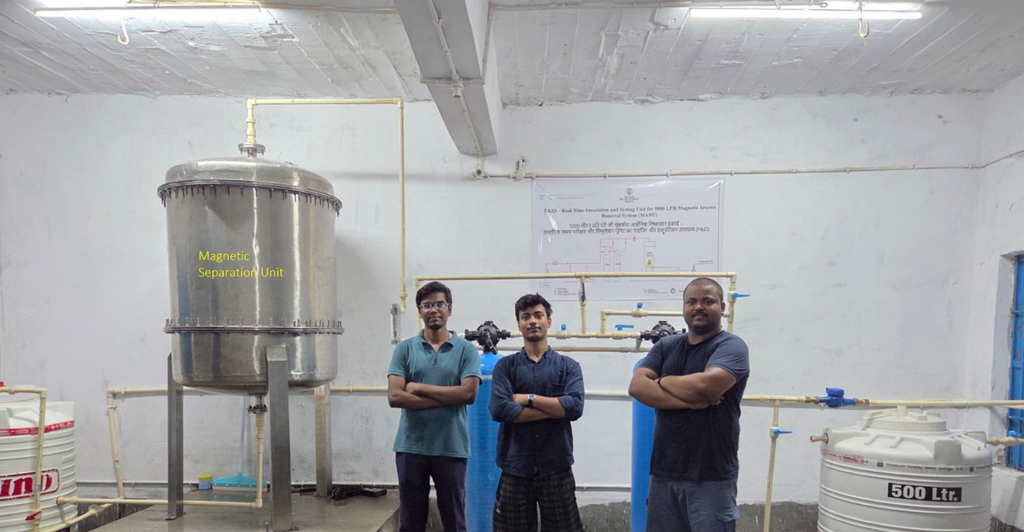
Most arsenic removal technology works on inauguration day. The real test arrives two years later, when the cartridges are spent and the nearest technician is three hours away. Navmarg Research and Innovation, a deep-tech water startup incubated at MAHE, Manipal, has built its company around that second test.
The Plant That Stopped Working
The World Health Organization sets a provisional guideline of 10 micrograms of arsenic per litre of drinking water. By its estimate, 140 million people in at least 70 countries have drunk water above that level. In India, the Ministry of Jal Shakti has recorded arsenic in groundwater across parts of 221 districts in 25 states and union territories, mostly along the Ganga–Brahmaputra floodplains of Bihar, West Bengal, Uttar Pradesh and Assam.
Chronic exposure causes skin lesions and cancers of the skin, lung and bladder. No medicine reverses it. The only intervention is to stop drinking the water.
Navmarg’s founder, Arpit Kumar, describes a case from 2025. Doctors at Mahavir Cancer Sansthan in Patna measured 400 micrograms per litre of arsenic in the breast milk of a mother from a village that already had an arsenic plant. The plant had been abandoned years earlier.
That pattern shows up in the research too. Studies of West Bengal’s community systems found roughly 82 percent of arsenic plants not working. The chemistry of removal is old and well understood. Keeping a plant alive on a village budget is the unsolved part.
How Does Magnetic Arsenic Removal Technology Work?
Navmarg’s METAL® arsenic removal technology captures arsenic-bearing iron particles with permanent magnets, so it needs no chemical dosing, membranes or replaceable media in the separation stage.
In practice, raw groundwater passes a sediment pre-filter and then enters a stainless-steel column. Inside, sealed neodymium magnet arrays sit in conical stages and create steep magnetic field gradients. In the aquifers of the Gangetic plains, arsenic travels largely with iron, as arsenic–iron complexes and fine colloids. Those particles respond to a magnetic gradient more strongly than water does, so they are drawn onto capture surfaces while clean water moves on. A caretaker periodically flushes the collected solids through a drain, and a UV stage in the storage tank guards against fresh contamination.
The company is careful about what this does not mean. The magnets do not pull individual arsenic ions out of water. The method depends on iron already present in the source, and low-iron sites may need pretreatment. That is why every site gets a 16-parameter water survey before a unit is quoted. The magnetic field draws no electricity, though pumps still do.
The Field Record Behind the Claims
The performance numbers for this arsenic removal technology come from a sequence of pilots, and the company attaches a site and a period to each.
- 2020, Maner, Patna: 28,937 litres treated over 30 days, arsenic falling from 141 to below 1 microgram per litre.
- 2021 to 2022, Bhojpur and Buxar: three middle schools and two handpumps with PHED Bihar, about 6.28 lakh litres, from 109 to below 2.
- 2023, Bhojpur and Buxar: five middle schools supported by UNICEF Bihar, serving 2,300 children, about 22.15 lakh litres, from 126 to below 2.
Across 13 validated sites, MARU™ units have treated about 3.19 million litres since 2020. Scientists from CSIR-CGCRI and CSIR-IICT reviewed the systems on site. In January 2023 the technology was empanelled under the Jal Jeevan Mission after review by a committee chaired by the Principal Scientific Adviser. Pilot deployments are now running in Raichur, Karnataka, with the state’s Rural Drinking Water and Sanitation Department.
Operating cost is about ₹8 per 1,000 litres, according to the company, and most of that is electricity to pump raw water. Units range from 400 to 2,000 litres per hour, and a modular version stacks them for larger sites. Health outcomes are not yet causally measured, which is worth remembering when reading any impact figure.
Sensors and Data Around the Filter
Arsenic removal technology is only half the job. Most rural sources get tested a few times a year, and a sample can take days to reach a laboratory. Navmarg is building two products to close that gap.
µSENSE is a set of in-line sensor modules for arsenic, iron and microbial contamination, meant to give same-day readings at the source. The microbial work is backed by the NIDHI-PRAYAS programme of the Department of Science and Technology through MUTBI. Patent filings are underway, so the company is holding back technical detail.
AquaInsight converts Central Ground Water Board quality reports, mostly published as PDFs, into a structured database and map covering 27 parameters. Karnataka is built first. A district engineer could see where contamination clusters before a borewell is drilled. A pilot with WaterAid Bihar has been proposed but is not yet signed.
From School Project to Funded Company
The work began in 2018, when the founding students were at Bihar Bal Bhawan Kilkari in Patna. A first prototype was demonstrated at CSIR-IICT in 2019, and Navmarg was incorporated in September 2023. The team includes Arpit Kumar as CEO, Abhijeet Kumar as CTO, Shambhavi Sinha on technology and analytics, and Akshat Adarsh on environmental and regulatory affairs.
The intellectual property stands at one granted Indian patent, three registered designs and one PCT publication, with a US application in process. Funding and support have come from Samsung Solve for Tomorrow, ICICI Foundation, the Karnataka government’s RDWSD grant and NIDHI-PRAYAS. Recognition in 2026 includes the Hult Prize India National title, an ASME ISHOW India award with USD 10,000, the India Water Foundation’s Innovation in Water Technology Award and a national finalist spot on Vande Bharatam. Sales run through Jal Jeevan Mission empanelment, the GeM portal and CSR partnerships.
What Investors and Funders Should Watch
The pitch for this arsenic removal technology is uptime, and it is a sharp one. Buyers of rural water systems have spent decades judging projects on installation day. A company that sells on year-two performance aims at the exact failure that drains public and CSR budgets.
Three items deserve scrutiny. The consumables-light claim needs multi-year data from more sites. The scale trial in Bhojpur, at 4,500 litres per hour, is still early. And the plan to extend into chromium, nickel and other metals between FY27 and FY29 is, by the company’s own framing, a hypothesis with validation gates.
Even so, Navmarg has something many arsenic removal technology startups lack: a field record with named sites, lab-tested results and government empanelment behind it. For funders, the useful question is no longer who can install a plant. It is who can still be producing safe water in year two.
Related Link : https://launch91.com/startups/iit-madras-unicorn-india-ventures-deeptech-fund-i-first-close-450-cror/