Every lead-acid battery in an e-rickshaw, inverter or truck carries a small dose of carbon in its negative plate. The quality of that carbon decides how fast the battery accepts charge and how long it lasts.
Jaipur-based Cancrie makes nanocarbon for batteries from coconut shells and farm residue. The company says its material lifts charge acceptance by 60% and is now used at more than 20 Indian battery manufacturers.
Why India needs homegrown nanocarbon for batteries
India is building a domestic battery industry at speed. The government’s PLI scheme for Advanced Chemistry Cell storage set aside Rs 18,100 crore to build 50 GWh of cell manufacturing capacity.
Cells are only one layer of that supply chain. Cancrie’s founders argue that active materials, carbons and additives are the next gap, and that importing them leaves Indian battery makers exposed to price swings and shipping delays.
Lead-acid batteries remain the workhorse for e-rickshaws, solar backup and vehicle starting. Better carbon in those batteries means faster charging and longer life for millions of low-cost users who cannot yet afford lithium.
How Cancrie turns farm waste into battery material
Cancrie’s founders tested 15 waste streams, from fruit stones and palm kernel shells to paper waste, before settling on coconut shells for their wide availability, The Better India reported. Feedstock is sourced from small and marginal farmers.
A patented process
A patented process converts that biomass into a high-surface-area carbon with a controlled nanostructure. The company says its route uses 75% less energy than conventional methods and cuts greenhouse gas emissions 13-fold.
Inside a lead-acid battery, this nanocarbon for batteries acts as an expander in the negative plate. It lowers internal resistance and helps more of the active material take part in each charge and discharge.
What the test data shows
Cancrie publishes test results on its website. It reports 60% higher charge acceptance, which it says was verified with ARAI, India’s automotive testing agency.
In a tubular flooded battery cycled at 80% depth of discharge, cells using its nanocarbon for batteries ran 1,100 cycles against 900 for regular carbon. The company also reports 3x higher peak power in motor-starting batteries and up to 25% higher energy density.
Beyond lead-acid
The same material platform has minimum viable products in lithium-ion, sodium-ion and vanadium redox flow batteries, along with supercapacitors. That gives Cancrie a route into newer chemistries as India’s cell factories come online.
Traction: nanocarbon for batteries on production lines
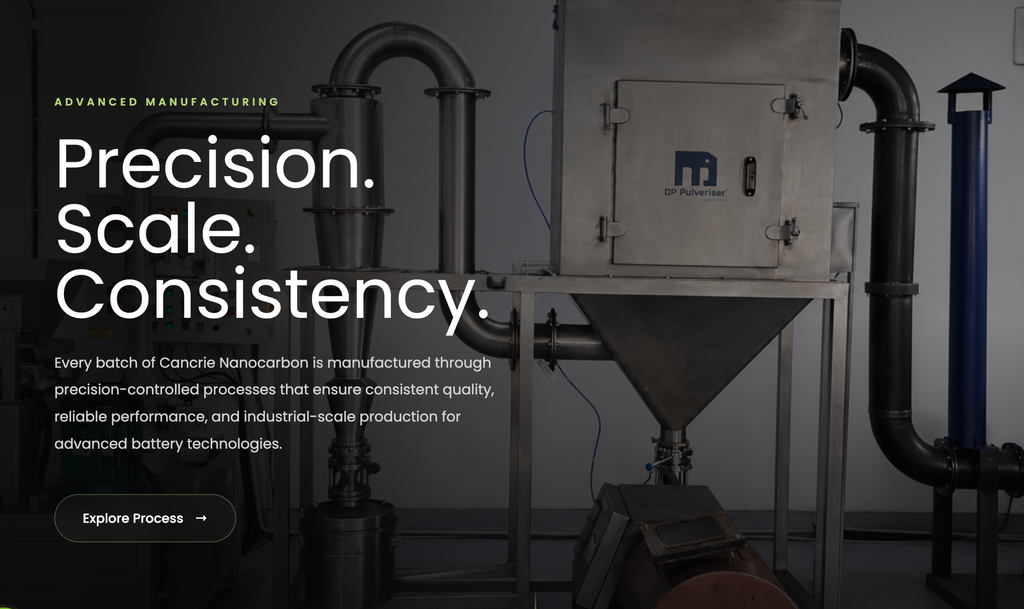
Cancrie runs a pilot facility at the RIICO industrial area in Jaipur. Output there has grown from one gram a day at lab scale to 2,000 grams a day, YourStory reported in 2023.
The company says its nanocarbon is now proven at industrial scale with more than 20 battery manufacturers. It reports that its material has gone into tubular, motor-starting, e-rickshaw and VRLA batteries sold across India over the last two years.
Recognition has followed. Cancrie won the Energy Transitions Innovation Challenge (ENTICE) in 2023, announced at the Energy Transition Dialogues in New Delhi. The Better India reports it also received a national energy efficiency innovation award from the Bureau of Energy Efficiency that year.
The founders: a scientist and a strategist from Jaipur
Akshay Jain (CEO) and Mahi Singh (COO) grew up together in Jaipur and launched Cancrie in 2020.
Jain holds a PhD in Chemical and Biomolecular Engineering from the National University of Singapore, where he began researching carbon materials in 2010. He has two patents and 15 peer-reviewed publications to his name.
Singh studied at Nanyang Technological University in Singapore and built her career in strategy and marketing before turning to climate work. She runs the commercial side, taking a lab material to battery plants that buy on cost and consistency. Former Luminous CEO Rajarshi Sen advises the company.
Why investors should watch Cancrie
Timing. India’s cell manufacturing push creates demand for domestic battery materials, and lead-acid makers face pressure to close the performance gap with lithium. A local nanocarbon supplier answers both.
Wedge. Cancrie entered through lead-acid, a large, price-sensitive market where a drop-in additive can be adopted without retooling a factory. That gives it revenue and field data while newer chemistries scale.
Model. It sells B2B to battery manufacturers as a materials supplier. Once a carbon is qualified into a battery recipe, manufacturers tend to stay with it, which makes each qualification a long-term account.
Backers. Cancrie raised a $1.2 million seed round in January 2025, led by Roots Ventures with IIMA Ventures, Foundation Botnar and Sagana, Entrackr reported. The funds are for scaling production and R&D.
Next milestones. The proof points to watch are a full-scale commercial plant and the first qualification of Cancrie nanocarbon for batteries in a lithium-ion or sodium-ion cell line. Either would move the company from additive supplier to a core materials partner for India’s battery industry.
For more on India’s battery and clean-tech builders, read Launch91’s profile of Inventus and its solid-state battery and our story on Carbon Masters turning food waste into biogas.
The bigger opportunity
India’s farms produce vast volumes of residue every year, and its battery makers need more advanced materials. Cancrie connects the two.
If its nanocarbon for batteries keeps qualifying into new chemistries, a coconut shell from a small farm could end up as part of India’s battery supply chain. That is the company the founders are building.
FAQ
What is nanocarbon for batteries?
Nanocarbon for batteries is a carbon material with a very fine, high-surface-area structure. Added to electrodes, it lowers internal resistance and improves charge acceptance and cycle life.
What does Cancrie make its nanocarbon from?
Cancrie uses agricultural and industrial residue, mainly coconut shells, sourced from small and marginal farmers. A patented process converts the waste into battery-grade carbon.
Where is Cancrie based?
Cancrie is based in Jaipur, Rajasthan, and runs a pilot production facility at the RIICO industrial area there. It was founded in 2020.