In a small test cell in Chennai, a methane and oxygen ignitor fired hard enough to melt its own test article. The team at Cosmo Crawler Space Exploration filmed it anyway. The footage showed Mach diamonds, the bright shock pattern of supersonic exhaust, and gave them the data they needed to redesign.
That is how early space hardware gets built in India today: 3D-printed parts, short tests and quick fixes. Cosmo Crawler is using that loop to work on a problem most launch startups leave for later, which is rocket landing technology for vehicles that bring cargo home.
Founder Yoga Raj puts the thesis plainly. Rockets will soon carry things back from orbit as well as up to it, so landing safely matters as much as launching cheaply.
The problem with rocket landing technology today
Two models dominate how spacecraft come home. In Yoga Raj’s framing, SpaceX’s vertical propulsive landing has made reuse cost-effective but carries risk on every touchdown. NASA’s Space Shuttle glided to a runway with a strong safety record for its cargo but needed vast infrastructure and refurbishment between flights.
Cosmo Crawler wants the useful parts of both. Its answer is a hybrid landing vehicle that returns payloads from space at lower cost and lower risk.
That framing matters for customers. A satellite operator cares about the trip up. A company making drugs, crystals or semiconductor samples in orbit cares just as much about getting the product back intact.
How Cosmo Crawler’s hybrid landing vehicle works
The company describes its design as a fully reusable launch vehicle with hybrid landing systems. These combine proven recovery methods with new control logic that decides how the vehicle descends and touches down.
The full landing architecture is still in development, and the team has started with propulsion, because precise engine control sits at the heart of any landing system.
Prototype 1: a 3D-printed control thruster
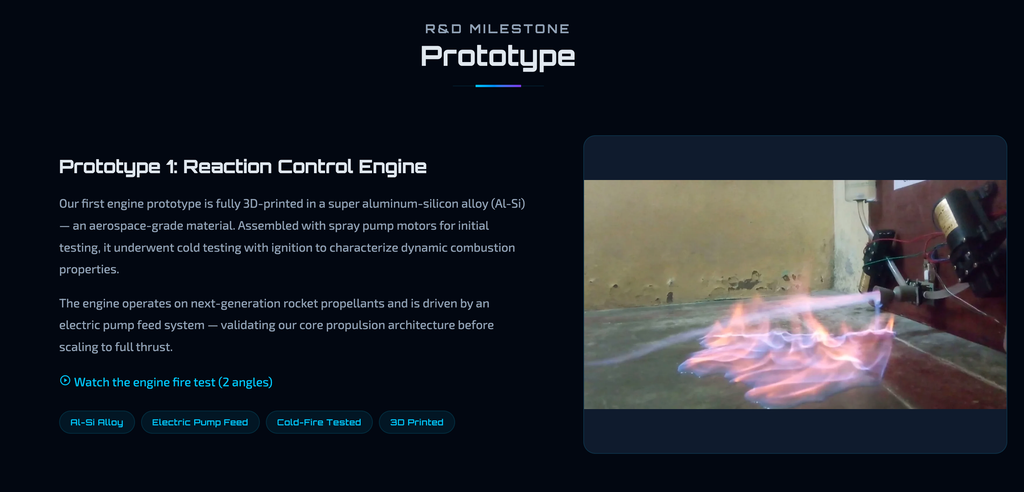
The first hardware is a reaction control system (RCS) engine, the small thruster that orients a vehicle in flight and during descent. It is 3D-printed in an aluminium-silicon alloy and fed by an electric pump. It has completed cold-fire tests.
CAIMAN 2000: the main engine
Next comes CAIMAN 2000, a micro-category liquid rocket engine that is also 3D-printed. The company rates it at 1,000 kgf at 60 bar chamber pressure and over 2,200 kgf at full thrust.
The key feature is restart capability. An engine that can shut down and relight in flight is a basic requirement for controlled rocket landing technology, because the vehicle needs thrust again at the end of its descent.
Ignition and test results
Cosmo Crawler has also tested a methane and gaseous oxygen ignitor and is working on a kerosene-oxygen engine called Mugger. The team calls the melted ignitor a small milestone that validated several design choices before a planned re-test.
Why rocket landing technology matters now
India’s space sector has opened to private companies in just a few years. IN-SPACe, the national authorisation body, has set out a decadal vision to grow the Indian space economy to $44 billion by 2033, with startups at the centre of the plan.
The demand is moving beyond launch. In-orbit research, space manufacturing and returnable experiments all need a reliable ride home. A top official has said the sector has the potential to reach that figure, ThePrint reported. Return missions are a natural place for rocket landing technology to earn revenue.
A vehicle that lands cheaply and safely could serve both directions of that market: carrying payloads up and carrying finished products down.
Traction and proof so far
Cosmo Crawler is at the MVP and prototype stage. Its first-flight roadmap lists six completed milestones: mission design, propulsion research, CAD design, additive manufacturing, prototype assembly and cold-fire testing.
Two programmes are in active development, the hybrid rocket landing technology R&D and the CAIMAN 2000 engine. Vehicle integration comes next.
The company’s website lists support from the University of Madras and the Atal Incubation Centre network. The founder reports raising under $100,000 to date, which makes the hardware output so far notably capital-efficient.
The team behind Cosmo Crawler
Yoga Raj leads the company as founder. He has built a compact engineering group with advisors from the sciences, including Dr. S. Ekambaram in physical chemistry and K. Reivanth in materials science.
The core team includes research assistant Bharath Karthick, engineer Naveen Kumar and project associate Ramanan. Chemistry and materials are central to engine combustion and to heat-shield and structure choices, so the advisory mix fits the problem.
Why investors should watch Cosmo Crawler
Timing. India’s space reforms and the IN-SPACe roadmap have created a domestic market for private launch and return services. Global interest in returnable payloads is rising alongside in-space manufacturing.
The wedge. Most Indian launch startups focus on getting to orbit. Cosmo Crawler starts from the return leg and treats rocket landing technology as its core product.
Business model. The company is building for B2B customers. Revenue would come from launch and cargo-return missions for research groups, satellite operators and in-orbit manufacturers.
Capital efficiency. Engines are 3D-printed in-house, which shortens design cycles and keeps test costs low. The team has reached ignition and cold-fire testing on a sub-$100,000 budget.
Next milestone. The proof point to watch is a hot-fire test of CAIMAN 2000 with a successful in-flight restart profile, followed by a scaled landing demonstration. Either would give investors hard data on the hybrid approach and set up a seed round.
The bigger opportunity
Every rocket that launches today is designed around the trip up. The next decade will reward companies that can also bring value back down, safely and often.
Cosmo Crawler is building toward that future from Chennai, one printed engine and one test at a time. If its rocket landing technology works at scale, India will have a homegrown answer to one of the hardest problems in spaceflight.
Read more Indian deep tech stories on Launch91, including OmSpace’s reusable rocket, Infinity One, and Rekise Marine’s autonomous submarines.
FAQ
What is Cosmo Crawler building?
Cosmo Crawler is a Chennai-based space startup building a fully reusable vehicle with hybrid landing systems, designed to bring cargo back from space at lower cost and lower risk.
What is hybrid rocket landing technology?
Hybrid rocket landing technology combines established recovery methods with new control logic, aiming for the reuse economics of propulsive landing with the safety margins of gliding return vehicles.
What stage is Cosmo Crawler at?
The company is at the prototype stage. It has cold-fire tested a 3D-printed control thruster and is developing CAIMAN 2000, a restartable liquid engine.